
 Signify.ink

A first impression in the physical world is a complex, multi-second affair — posture, tone, eye contact, attire, and the first few sentences all contribute. A first impression online is compressed into a fraction of that time. The research is unambiguous: visual appeal of a web page is assessed in roughly 50 milliseconds , and trait judgments from a face — including trustworthiness — happen in about 100 milliseconds . That is faster than a blink. It means that by the time a visitor has finished scrolling the top of your profile, they have already formed a stable impression of who you are. This article examines what the psychology literature actually says about how that impression forms, which principles are real versus overstated, and what it means for designing a digital business card or professional profile that builds trust rather than undermining it.
How fast trust judgments actually form
Two peer-reviewed studies anchor the “first impression in seconds” claim. Both are widely cited across UX, marketing, and psychology, and both are worth understanding at the level of what they actually measured.
The 50-millisecond web judgment
In 2006, Gitte Lindgaard and colleagues at Carleton University published a study in Behaviour & Information Technology showing that users can assess the visual appeal of a web page after only 50 milliseconds of exposure, and that these immediate judgments correlate strongly with judgments made after longer viewing. The Nature news report summarised the finding plainly: “Visual appeal can be assessed within 50 milliseconds, suggesting that web designers have about 50 ms to make a good first impression.”
What the study measured was aesthetic judgment — whether a page looked appealing — not a deep assessment of trustworthiness. But aesthetic judgment is a gateway: if the page fails at the 50ms stage, the visitor is unlikely to invest the seconds required for a deeper evaluation. The paper’s practical implication is that visual quality at the top of a profile does disproportionate work, because there is no opportunity to override an initial aesthetic rejection.
The 100-millisecond trust judgment
Also in 2006, Janine Willis and Alexander Todorov at Princeton published a study in Psychological Science showing that judgments of trustworthiness, competence, likeability, aggressiveness, and attractiveness from a face are formed after 100 milliseconds of exposure, and that these judgments correlate highly with judgments made without time constraints . The paper found that of the five traits measured, trustworthiness had the highest correlation between rapid and extended judgments.
Two things about this finding are worth taking seriously. First, the trust judgment happens essentially instantly — before the visitor has read a single word of your bio. Second, the judgment is stable: additional exposure time did not significantly change the trait assessments, only the confidence with which they were held. That is why a low-quality photo can poison a profile that is otherwise well-written. The visitor formed a trust judgment from the photo before the text had any chance to counter it.
The Halo Effect
The Halo Effect is the tendency for a positive impression in one domain to spill over into unrelated domains. It was first described by the psychologist Edward Thorndike in 1920, when he observed that commanding officers rated their soldiers’ physical appearance, intelligence, and leadership on highly correlated scales — as if one positive trait implied the others. The concept is now standard in social psychology; the Wikipedia overview is a good starting reference.
What the research shows
Modern research has repeatedly confirmed that the Halo Effect is not a minor curiosity — it is one of the most robust biases in impression formation. The Cleveland Clinic’s clinical overview of the effect explains it succinctly: “perceiving one positive quality in a person can create a ‘halo’ of positivity that extends to other, unrelated attributes” . The Lindgaard study itself notes that the Halo Effect applies to websites: “if you can snare people with an attractive design, they are more likely to overlook other minor faults with the site.”
What it means for a professional profile
The Halo Effect is the mechanism behind why a professional photograph carries so much weight. A well-lit, clear, professional headshot creates a positive halo that makes the visitor interpret the rest of the profile — the bio, the links, the spelling — more favourably. A blurry or outdated photo creates a negative halo that makes the same content seem less credible. This is not a design preference; it is a documented cognitive bias. The practical implication is that the photo is not the first thing to fix — it is the first thing to fix well.
For a Signify profile, the photo is set at the card level and appears everywhere the card is shared. That consistency matters: the same high-quality photo across the card, email signature, and any linked social profiles reinforces the halo instead of fragmenting it.
Cognitive ease
Cognitive ease — sometimes called processing fluency — is the subjective experience of how easy it is to process information. Research in cognitive psychology (associated most visibly with Daniel Kahneman’s work) has shown that information that is easy to process is experienced as more true, more familiar, and more trustworthy than information that is hard to process, even when the underlying content is identical. The reverse is also true: disfluent information — small text, clutter, jargon, odd fonts — produces a subtle sense of unease that can read as distrust. The processing fluency overview covers the research literature well.
What disfluency looks like on a profile
- Multiple competing visual elements with no hierarchy
- Jargon the audience does not use
- Small text on a mobile screen
- Cluttered layouts that require scrolling to understand
- Inconsistent fonts, colours, or visual styles
- Broken or slow-loading links
Each of these creates a small cognitive cost, and the cumulative cost reads as “this profile is not worth my attention.” The professional who invests in a clean, readable, mobile-first profile is not just making a design choice — they are exploiting a documented cognitive bias in their favour.
What fluency looks like
A Signify profile is designed as mobile-first and browser-hosted, which means it opens in a layout optimised for the device the visitor is already holding. The typography, spacing, and hierarchy are fixed by the platform so the professional does not have to hand-design them. That is a structural advantage over a hand-built profile or a PDF, where the professional has to get the design right themselves. The point is not that Signify is aesthetically perfect — it is that it removes one category of cognitive friction that a hand-crafted profile is likely to introduce.
The Pratfall Effect
The Pratfall Effect was first demonstrated by Elliot Aronson and colleagues in a 1966 paper in Psychonomic Science. The setup: participants listened to recordings of a highly competent person and an average person, each answering quiz questions. In one condition, a clumsy blunder was introduced — the sound of a coffee cup clattering. The result: the competent person became more likeable after the blunder; the average person became less likeable. The original paper describes the finding precisely: a superior person may be viewed as superhuman and therefore distant; a blunder humanises him and increases attractiveness.
What the effect actually means
The Pratfall Effect is often cited in marketing as an argument for showing vulnerability. That is a reasonable reading, but the original research is narrower than the popular claim. The effect applies to people who are already perceived as highly competent — the blunder humanises them. For people who are not yet perceived as competent, the same blunder makes things worse. This is a critical distinction. A junior professional who leads with a self-deprecating anecdote has not discovered a shortcut to trust; they have undermined the competence they have not yet established.
How it applies to a professional profile
The practical implication is that a profile should establish competence first, then show humanity. A profile that opens with credentials, a clear role, and a specific value proposition is establishing the baseline competence that makes the later human detail read as authentic rather than as a substitute for substance. A profile that opens with a casual personal anecdote and no indication of what the person does is not exploiting the Pratfall Effect — it is failing at step one.
For professionals who already have a strong reputation, a small dose of human detail (a hobby, a behind-the-scenes note, a specific opinion) can round out the profile and make it more memorable. But the sequencing matters, and the effect does not work as a shortcut.
Where psychology fits — and where it does not
The four principles above are real and well-documented. But it is worth being honest about what they can and cannot do for a professional profile.
What they can do
Explain why the first visual element matters more than the total content. Explain why a clean layout outperforms a cluttered one with the same information. Explain why consistent identity across touchpoints reinforces trust rather than fragmenting it.
What they cannot do
They cannot substitute for actual competence. They cannot make a weak professional profile compelling through design tricks. They cannot guarantee a business outcome from a single interaction. They are a lever, not a shortcut.
This is where the original article overstated things. The framing implied that understanding the psychology of trust is a sufficient condition for building a trustworthy profile. It is not. It is a necessary condition for making a good profile work at the rate it should. The content — the work, the credentials, the relationships — is what the psychology amplifies. Without the content, the psychology is decoration.
What a Signify profile changes
A Signify digital business card is a browser-hosted professional profile. It is shared via NFC tap, QR code, direct link, or email signature. It is not a social network and it does not carry endorsements or ratings — so it does not create social proof on its own. What it does is give the professional a clean, consistent, mobile-optimised surface for the identity signals that psychology research says matter: a clear photograph, a legible name and role, a short bio, and a curated set of links.
What it makes easier
- Consistency across surfaces. The same photo, bio, and links appear on the card, the email signature, and any widget embedded on the website. The Halo Effect works in the professional’s favour every time the profile is encountered, rather than fragmenting across mismatched surfaces.
- Cognitive ease by default. The layout is mobile-first and typographically fixed, which removes the category of disfluency that hand-built profiles often introduce.
- Currency. When the professional changes role, company, or contact details, the profile updates once and every saved copy reflects the change. A stale profile undermines the halo; a current one reinforces it.
- Trust by predictability. A Signify QR code always opens at
signify.ink, never a third-party page or login prompt. For a visitor who has been trained to be cautious about QR codes, that predictability is itself a small trust signal.
What Signify does not do is manufacture social proof or substitute for competence. A profile that links to a substantive portfolio, published work, or a well-maintained professional presence is doing the social-proof work through the underlying material. The profile is the surface; the work behind it is what the surface is meant to communicate.
Applying the principles in practice
The psychology suggests a specific order of operations for building or auditing a professional profile. The order matters because earlier elements affect how later elements are interpreted.
- Fix the photograph first. A clear, current, professional headshot is the single highest-leverage element on the profile because the Halo Effect and the 100ms trust judgment both operate through it. A weak photo makes every other element less effective.
- Make the name and role immediately legible. The visitor should not have to hunt for who you are or what you do. Legibility is the baseline of cognitive ease.
- Write one specific line, not three generic ones. A specific bio (“I help B2B SaaS founders turn cold outbound into warm pipeline”) outperforms a generic one (“passionate about sales”) because it gives the reader something concrete to hold onto.
- Curate the links. Three or four strong links — LinkedIn, a portfolio or website, a booking link, one messaging channel — outperform a list of ten. Too many options create decision friction, which reads as cognitive strain.
- Provide social proof where you have it. A link to a published article, a specific case study, or a portfolio page that the visitor can actually open does more work than a generic “trusted by clients” line.
- Show a human detail — after establishing competence. A brief line about a hobby, a specific opinion, or a behind-the-scenes note can round out the profile. It works because the professional has already established what they do.
For teams, Signify Teams adds organization card templates — the shared logo, theme, and required fields — so that every employee’s profile maintains a consistent visual identity. That consistency is the thing that makes the Halo Effect compound across an organization instead of fragmenting across individuals.
Frequently asked questions
How quickly do people actually form first impressions online?
The research points to 50 milliseconds for visual appeal of a web page (Lindgaard et al., 2006, Behaviour & Information Technology) and 100 milliseconds for trait judgments from a face, including trustworthiness (Willis & Todorov, 2006, Psychological Science). The commonly cited “7 seconds” figure for first impressions is not supported by peer-reviewed research — it is communication folklore. The actual research shows the judgment is faster, not slower.
What is the Halo Effect, and does it apply to professional profiles?
The Halo Effect is the tendency for a positive impression in one domain to spill over into unrelated domains — a well-known cognitive bias first described by Edward Thorndike in 1920. It applies directly to professional profiles: a polished, professional photograph makes the visitor interpret the rest of the profile more favourably, while a low-quality photograph does the opposite. The Cleveland Clinic’s clinical overview describes it as “a shortcut that our brain makes” when evaluating one positive quality in a person.
What is social proof, and how does it work on a professional profile?
Social proof is the tendency to use the behaviour of others to guide our own decisions, especially under uncertainty. Robert Cialdini popularised the concept in Influence: Science and Practice (1984). On a professional profile, social proof appears as testimonials, client logos, links to substantive work, and endorsements. Signify does not build social proof into the profile — the professional provides it through the links and material they choose to share.
What is cognitive ease, and why does it matter for a profile?
Cognitive ease (or processing fluency) is the subjective experience of how easy information is to process. Research shows that easy-to-process information is experienced as more true, more familiar, and more trustworthy than hard-to-process information, even when the content is identical. On a profile, cluttered layouts, jargon, small text, and broken links create cognitive strain that reads as distrust. Clean, legible, mobile-optimised layouts create cognitive ease.
What is the Pratfall Effect, and should I show vulnerability on my profile?
The Pratfall Effect was demonstrated by Aronson et al. in 1966 — a highly competent person becomes more likeable after a small blunder, while an average person becomes less likeable. The effect applies to people who are already perceived as competent. It does not work as a shortcut for people who have not yet established competence. A profile should establish credentials first, then show human detail. A self-deprecating anecdote that arrives before any indication of what the person does is not exploiting the effect — it is failing at step one.
Does Signify guarantee my profile will build trust?
No. Signify provides a clean, consistent, mobile-optimised surface for professional identity. It removes some categories of friction (cluttered layouts, inconsistent identity across touchpoints, stale contact information). But trust is built by the professional’s actual work, credentials, and relationships. The psychology research explains why a well-designed surface amplifies what is already there; it does not explain how to manufacture trust without substance.
What is the single highest-leverage change I can make to my profile?
A clear, current, professional photograph. The Halo Effect and the 100ms trust judgment both operate most strongly through the face. A weak photograph limits the effectiveness of every other element on the profile; a strong one amplifies them. After the photograph, the next highest-leverage change is a specific bio line that tells the visitor exactly what you do.
Do recipients need an app to view a Signify profile?
No. The profile opens in a standard web browser on any smartphone, tablet, or computer. There is nothing to download, no account to create, and no compatibility issue to manage. That matters for trust because a visitor who has to install something to see your profile is a visitor who may not.
How does Signify Teams help with consistency across a team?
Signify Teams provides organization card templates that lock the shared logo, theme, and required fields while preserving individual employee details. When the company rebrands, the template updates once and the change propagates across every employee card. That consistency is what makes the Halo Effect compound across an organization rather than fragmenting.
What is the first step?
Create a free Signify card, add a clear professional photograph, a specific one-line bio, and three or four strong links. Test the profile on a device that is not yours. The whole setup takes about ten minutes, and the free tier is enough to evaluate the workflow.
Give the psychology a better surface to work with
A clean, consistent, mobile-optimised profile that makes the first 50 milliseconds count — and stays current every time the card is saved.
Create your free digital card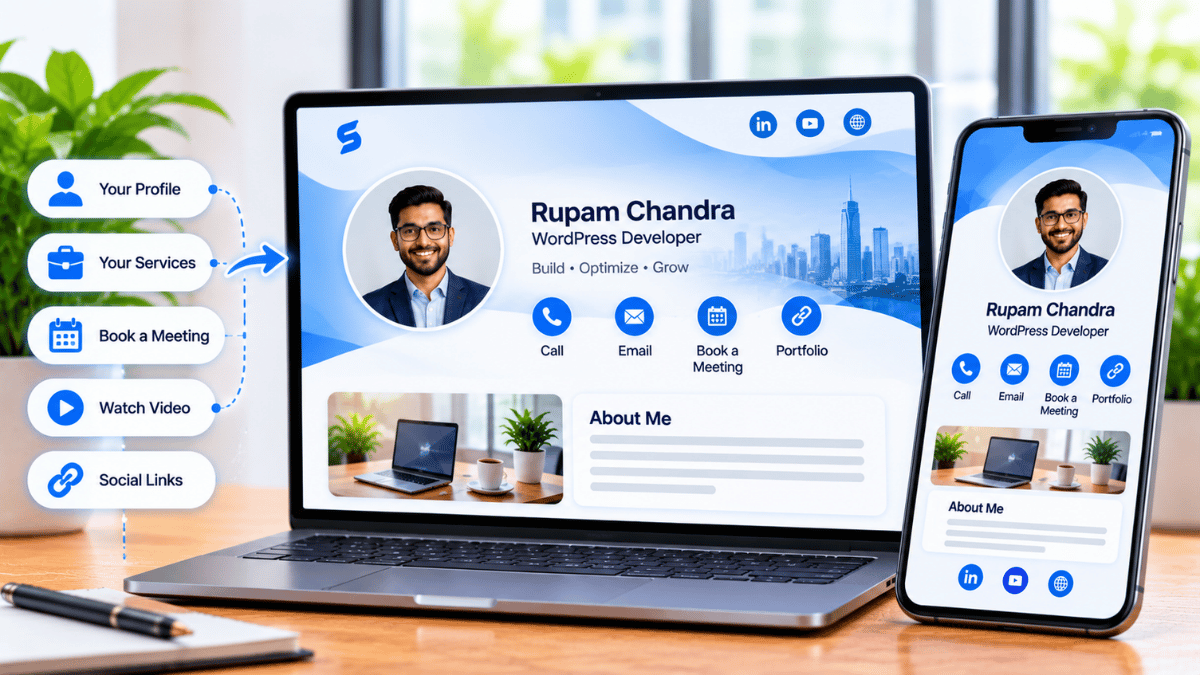


Social proof
Social proof is the tendency to use the behaviour of others as a guide for our own — especially in situations of uncertainty. The concept was popularised by Robert Cialdini in his 1984 book Influence: Science and Practice, where it is one of six principles of persuasion. Cialdini’s research shows that when people are unsure, they look to peers to determine what a “correct” action looks like. The Wikipedia overview is a reasonable starting point; the original book is the primary source.
How social proof works on a profile
On a professional profile, social proof takes several forms: testimonials, client logos, links to reputable social profiles, endorsements, and evidence of engagement (published articles, speaking engagements, active professional communities). Each of these signals to a visitor that someone else has already vetted and trusted this person. The visitor does not have to do the assessment themselves — they borrow someone else’s assessment.
For a Signify digital business card, social proof is not a built-in feature — the platform does not display endorsements or ratings. It is the professional’s job to include the right links and material. A profile that links to a substantive portfolio, a few published pieces, and a well-maintained LinkedIn is providing social proof through the underlying work. A profile that links to nothing substantive is providing none.
The limit of social proof
Social proof is powerful but not infinite. Research on persuasion shows that social proof works best when the referent group is similar to the audience — “people like you chose this” is more persuasive than “everyone chose this.” For a professional profile, that means generic testimonials from unrelated industries do less work than specific testimonials from the audience the profile is aimed at. A testimonial from a peer in the visitor’s field is worth more than a page of generic praise.