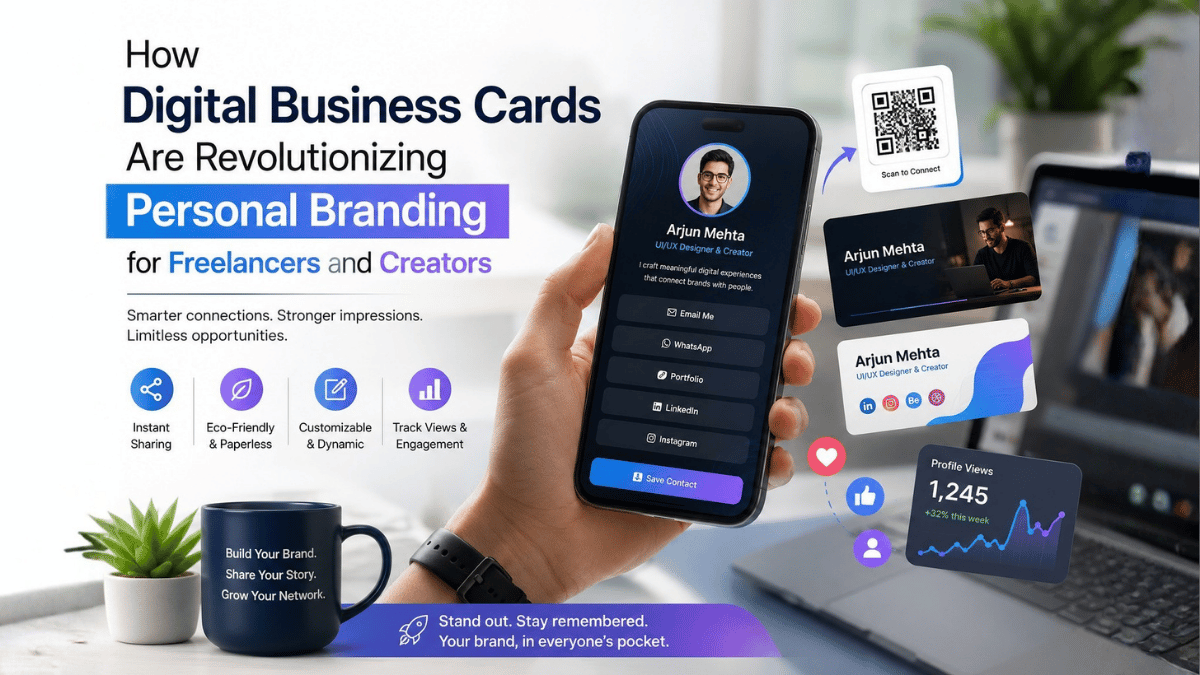
How Digital Business Cards Are Revolutionizing Personal Branding for Freelancers and Creators
A digital business card can bring your professional identity, portfolio, social presence, and contact options together into one modern introduction.
The modern handshake
“Here is who I am, what I do, and where you can see my work.”
The old introduction
A handshake, an introduction, a business card, and a follow-up.
The new introduction
A connected digital identity that can lead directly to your work, profiles, and contact options.
The opportunity
Turn a short networking moment into a professional relationship that continues after the conversation.
A handshake used to be the beginning of a professional relationship.
You met someone, introduced yourself, exchanged a business card, and continued the conversation later.
But professional networking has changed.
Today, a freelancer may meet a potential client through a conference, a creator may connect with a brand through a social event, and a consultant may be introduced to a new business partner through a video call. Professional relationships now begin across physical and digital environments.
The traditional business card, however, was designed for a much simpler world.
It typically contains a name, job title, company, phone number, email address, and perhaps a website.
For freelancers and creators, that can be limiting.
Your work is your brand.
Your portfolio is your credibility.
Your social presence is often part of your professional identity.
Your latest project may be more persuasive than a job title printed on a piece of paper.
This is where digital business cards are changing the way independent professionals introduce themselves.
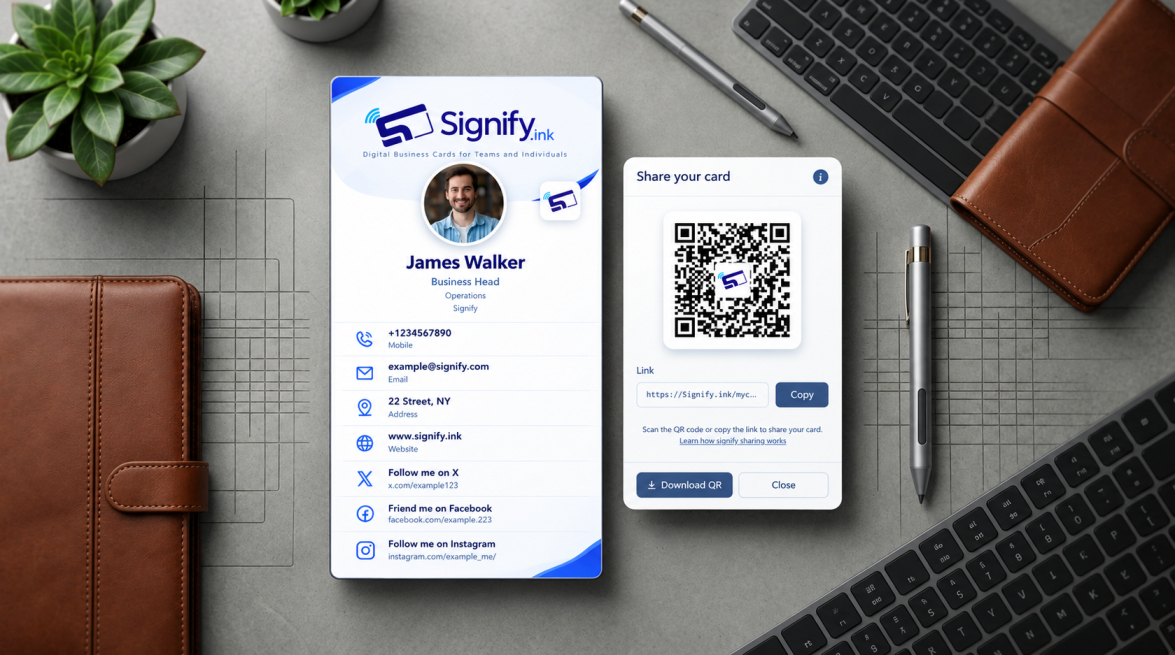
A digital business card can combine professional information, personal branding, portfolio links, social profiles, contact options, and other digital content into one easily shareable profile.
That is the modern handshake.
The Evolution of the Business Card
Business cards have served a useful purpose for centuries.
They provided a simple physical representation of professional identity and made it easier for people to reconnect after an introduction.
But the professional world has become increasingly digital.
Consider what a modern freelancer or creator may need to communicate.
- ✓ A graphic designer might want to show a portfolio.
- ✓ A photographer may want to display a gallery.
- ✓ A filmmaker may want to share a showreel.
- ✓ A developer may want to link to GitHub and selected projects.
- ✓ A consultant may want to provide a booking link and case studies.
- ✓ A content creator may want to connect Instagram, YouTube, TikTok, a newsletter, and a personal website.
Trying to communicate all of this on a traditional business card is impossible.
A digital business card changes the format.
Instead of treating the card as the destination, it becomes an entry point to your professional identity.
Traditional Business Cards vs. Digital Business Cards
The difference is not simply paper versus pixels.
The real difference is static information versus an evolving professional identity.
Traditional Business Cards
Static Information
Once a paper card is printed, the information is fixed.
If you change your phone number, website, job title, company, or email address, the old cards remain outdated.
For freelancers and creators whose careers evolve quickly, this can become inconvenient.
Limited Space
A physical card has a very small amount of space.
You may be able to include a website or social handle, but you cannot realistically showcase your portfolio, latest projects, testimonials, videos, or complete professional profile.
Manual Follow-Up
The recipient may need to manually enter your details into their phone or search for you online.
Every additional step creates friction.
Difficult to Update
Updating a paper card means creating a new design and printing another batch.
That is particularly inefficient for professionals whose branding or services change frequently.
Digital Business Cards
Dynamic and Editable
A digital business card can be updated as your professional identity evolves.
You can change your role, contact information, portfolio links, social profiles, or other content without needing to distribute an entirely new physical card.
This is especially useful for freelancers and creators.
Your work changes.
Your services change.
Your clients change.
Your brand changes.
Your business card should be able to keep up.
More Than Contact Information
A digital business card can contain much more than a phone number and email address.
Depending on the platform and how you design your profile, it can include:
- ✓Professional photograph
- ✓Name and job title
- ✓Personal brand statement
- ✓Company or studio
- ✓Website
- ✓Portfolio
- ✓Social media profiles
- ✓Video
- ✓Project links
- ✓Contact buttons
- ✓Booking links
- ✓Phone
- ✓Location
- ✓Additional professional information
This turns the traditional business card into something closer to a mini professional profile.
Why Freelancers Need a Different Kind of Business Card
Freelancers often do not have the advantage of a large corporate brand behind their name.
Their personal reputation is the brand.
When a potential client meets a freelancer, they may immediately want to know:
What do you do?
What have you worked on?
Who have you worked with?
Can I see examples?
How can I contact you?
A conventional business card can answer only some of these questions.
A digital business card can connect the recipient directly to the answers.
Emma Williams
Freelance UX Designer
What I do:
I design digital experiences for SaaS and technology companies.
Portfolio:
Selected UX projects
LinkedIn:
Professional profile
Website:
Personal portfolio
Contact:
Email / Call / Save Contact
The introduction becomes more useful because the recipient does not have to search for the information separately.
Why Creators Benefit Even More From Digital Business Cards
Creators operate in an environment where visual proof matters.
A photographer does not want someone to simply read:
"Professional Photographer."
They want the person to see their work.
A filmmaker does not want to explain:
"I create commercial video content."
They want to show the reel.
A designer wants to showcase designs.
An illustrator wants to display artwork.
A YouTuber wants to show the channel.
A musician wants to share music.
A content creator may want to connect multiple platforms.
This is one of the biggest advantages of a digital business card.
Instead of telling someone what you can do, you can give them a direct path to seeing it.
Your Portfolio Is Part of Your Introduction
For many freelancers and creators, a portfolio is more powerful than a traditional résumé.
A client may not remember every detail of a conversation.
But they may remember seeing an impressive project.
This is why your digital business card should not be treated merely as an electronic contact card.
It can become the first layer of your portfolio experience.
Imagine meeting a potential client at an event.
You scan a QR code.
The profile opens.
The client sees your photograph and name.
They read your short professional description.
Featured Projects
- ✓ Brand identity project
- ✓ Website redesign
- ✓ Product photography campaign
- ✓ Video production project
Now the networking interaction has moved from conversation to evidence.
That is a significant difference.
The Modern Business Card Is a Gateway, Not a Destination
The traditional business card was designed to hold information.
The digital business card is designed to connect information.
Your name can connect to your portfolio.
Your portfolio can connect to your website.
Your website can connect to your booking system.
Your social profile can connect to your audience.
Your contact button can connect directly to a conversation.
This creates a professional ecosystem around a single digital identity.
That is why the value of a digital business card is not determined by how much information you can fit onto it.
The value comes from how effectively it connects the right person to the right information.
Personal Branding Starts With Recognition
Personal branding is not simply about having a logo.
It is about creating a recognizable professional identity.
When someone sees your name, photograph, design style, company, or content, you want them to associate those elements with what you do.
A digital business card can help bring those elements together.
Your profile can use consistent:
- ✓Photography
- ✓Brand colors
- ✓Logo
- ✓Typography
- ✓Professional description
- ✓Links
- ✓Messaging
The result is a more cohesive digital identity.
If your website says one thing, your LinkedIn profile says another, and your business card contains outdated information, the professional experience becomes fragmented.
What Makes a Digital Business Card Memorable?
A digital business card does not need to be complicated to be memorable.
In fact, simplicity is often more effective.
A strong profile should quickly answer three questions:
Who are you?
Your name, photograph, and professional identity should be immediately visible.
What do you do?
Your title and short description should make your expertise clear.
What should I do next?
Give the visitor a clear action.
- →View portfolio
- →Save contact
- →Visit website
- →Connect on LinkedIn
- →Book a meeting
- →Send an email
- →Call
The goal is to remove uncertainty.
Showcase Your Work Instead of Just Describing It
One of the strongest principles for freelancer and creator branding is:
Instead of:
"Experienced graphic designer specializing in brand identity."
Consider providing a direct link to three relevant branding projects.
Instead of:
"Professional videographer."
Provide a showreel.
Instead of:
"Content creator with experience in social media."
Show the channels, campaigns, or content you have created.
Your digital business card can become the bridge between your claim and your proof.
QR Codes Make Sharing Simple
One reason digital business cards have become popular is the simplicity of sharing.
A QR code can provide an immediate connection between an offline interaction and a digital professional profile.
At a conference, you can display your QR code on your phone.
At a trade show, it can appear on signage.
During a presentation, it can appear on the final slide.
On printed marketing material, it can provide access to your current digital profile.
The important part is that the QR code should lead to a useful destination.
A scan should not create another obstacle.
It should create a smooth path to your professional identity.
NFC Makes Face-to-Face Sharing Even More Convenient
NFC provides another method of digital contact sharing.
With compatible devices, contact information can be shared through a simple tap.
For professionals who attend frequent networking events, conferences, meetings, and client visits, this can make exchanging information faster.
Signify supports digital business card sharing through methods such as QR codes, NFC, links, email, and text, giving users multiple ways to share their professional identity.
The important idea is flexibility.
Networking does not always happen the same way.
Your digital identity should be easy to share wherever the conversation happens.
Digital Business Cards and Social Media
Freelancers and creators often maintain several online channels.
A designer might have:
- ✓Behance
- ✓Portfolio website
A creator might have:
- ✓YouTube
- ✓TikTok
- ✓X
- ✓Newsletter
A musician might have:
- ✓Spotify
- ✓YouTube
- ✓Website
A digital business card provides a central place to organize those channels.
Instead of saying:
"Search for me on Instagram."
you can provide a direct link.
Instead of asking someone to remember your username, you can make it immediately accessible.
This reduces friction and makes your digital presence easier to navigate.
One Digital Identity Across Multiple Platforms
Your digital business card should not compete with your website or social media.
It should connect them.
Think of it as the front door to your professional presence.
The card introduces you.
Your portfolio demonstrates your work.
Your website explains your services.
Your social profiles demonstrate your ongoing activity.
Your booking system facilitates the next step.
Your email or phone enables direct communication.
The digital business card connects all of these elements.
Keep Your Professional Identity Current
One of the most practical advantages of a digital business card is the ability to update it.
Freelancers frequently change:
- ✓Services
- ✓Pricing
- ✓Portfolio
- ✓Contact information
- ✓Availability
- ✓Website
- ✓Professional title
- ✓Social platforms
- ✓Brand identity
Creators experience similar changes.
A new platform may become important.
A new portfolio may replace older work.
A new collaboration may need to be highlighted.
A digital card can evolve alongside the person behind it.
With Signify, users can update their digital profile without needing to print and redistribute new cards.
This makes the digital card better suited to modern careers where change is normal.
The Environmental Advantage of Going Paperless
There is also a practical sustainability argument for reducing dependence on printed business cards.
Paper cards require materials, printing, transportation, storage, and eventual disposal.
Digital sharing removes the need to print a new card every time your details change.
That does not mean every digital activity has zero environmental impact.
Digital infrastructure also consumes energy.
But for professionals who frequently update their information or distribute large numbers of cards, digital sharing can reduce the need for repeated physical printing.
That is a more useful and responsible way to think about paperless networking.
Analytics Can Help You Understand Engagement
Traditional business cards provide almost no visibility after they are handed over.
You do not know whether someone looked at the card.
You cannot easily determine whether they visited your website because of it.
Digital platforms can provide a different experience.
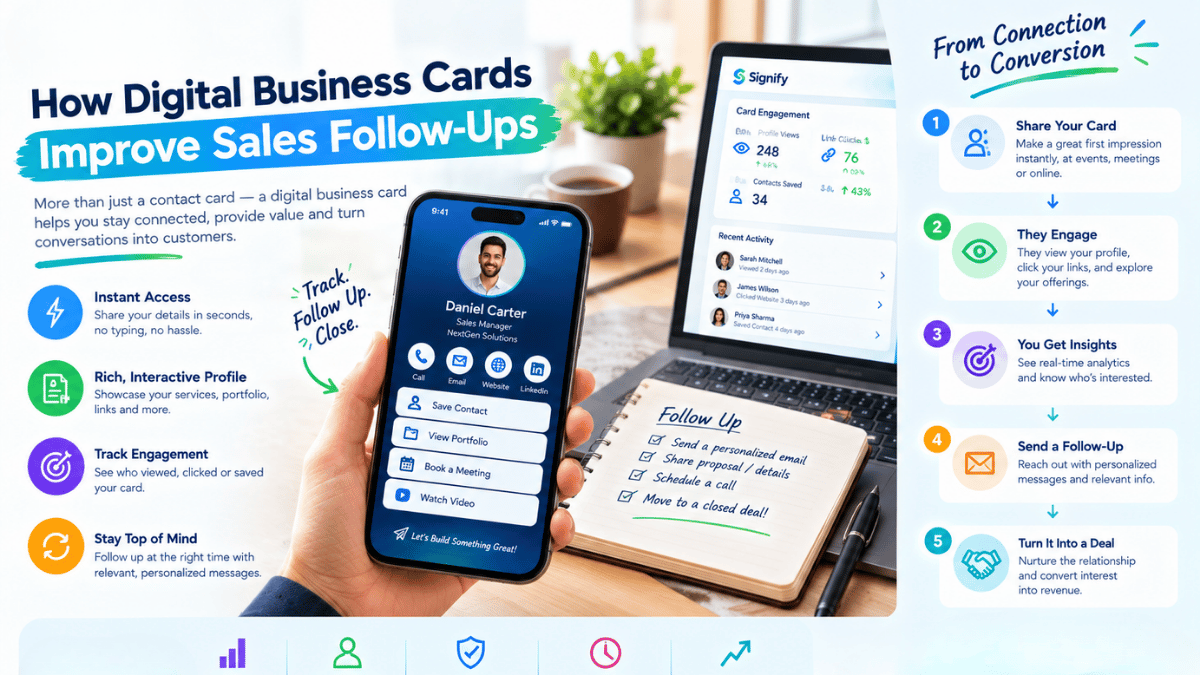
Depending on the platform and configuration, digital business cards can provide information about profile views, link interactions, and other engagement signals.
Signify provides analytics capabilities designed to help users understand engagement with their digital cards.
For freelancers and creators, this can provide useful feedback.
Analytics should not replace human judgment.
But they can help professionals make better decisions about their networking strategy.
Digital Business Cards for Freelancers: Practical Examples
Graphic Designers
A designer can use a digital business card to connect their professional identity directly to selected design projects.
Recommended content:
- ✓Name
- ✓Design specialty
- ✓Portfolio
- ✓Selected projects
- ✓Behance
- ✓Contact
Photographers
Photography is highly visual, making digital sharing particularly useful.
Recommended content:
- ✓Professional photograph
- ✓Photography specialty
- ✓Portfolio
- ✓Selected gallery
- ✓Booking link
- ✓Phone
Videographers
A videographer can use their card as a direct entry point to their reel.
Recommended content:
- ✓Showreel
- ✓Portfolio
- ✓Services
- ✓Previous clients
- ✓Website
- ✓Contact
Web Developers
Developers can showcase technical credibility through project links.
- ✓Professional specialty
- ✓Website
- ✓GitHub
- ✓Selected projects
- ✓Services
- ✓Contact
Consultants
Consultants can focus on credibility and conversion.
- ✓Expertise
- ✓Services
- ✓Case studies
- ✓Website
- ✓Testimonials
- ✓Booking link
Digital Business Cards for Creators: Practical Examples
YouTubers
A creator can connect their professional identity directly to their channel and other platforms.
Influencers
A digital card can consolidate brand collaboration information and social profiles.
Podcasters
The profile can link to podcast platforms, episodes, website, and contact information.
Musicians
Artists can connect listeners to streaming platforms, social profiles, website, and booking information.
Writers
Authors can connect to published work, portfolio, newsletter, social profiles, and contact information.
The Anatomy of an Effective Digital Business Card
A professional digital business card does not need dozens of features.
It needs the right information in the right order.
1. Core Profile
Your name, photograph, professional title, and short introduction.
2. Clear Brand Statement
Explain what you do and who you help.
3. Primary Action
Choose the action you most want people to take.
- →View Portfolio
- →Book a Call
- →Save Contact
- →Visit Website
4. Contact Options
Include relevant communication methods such as email and phone.
5. Portfolio
Show selected work rather than forcing visitors to search for it.
6. Social Profiles
Include only the platforms that are relevant to your professional identity.
7. Supporting Information
Add testimonials, case studies, services, videos, or other content where appropriate.
Best Practices for Creating a Digital Business Card
Prioritize Your Brand
Your digital business card should look like it belongs to you.
Use consistent branding across your website, portfolio, social profiles, and other professional materials.
Use a Professional Photograph
A clear photograph can make your digital identity more recognizable and personal.
Write a Strong Introduction
Avoid generic descriptions.
Instead of:
"Freelancer and creative professional."
Try:
Specificity communicates value.
Keep It Scannable
Visitors should understand your identity within seconds.
Use short descriptions, clear headings, and obvious actions.
Feature Your Best Work
Do not include every project.
Choose work that represents the type of opportunities you want next.
Keep Links Updated
Broken or outdated links can damage credibility.
Review your card regularly.
Make Contact Easy
Don't make someone search for your email address.
If the goal is to generate business, make the next step obvious.
Your Digital Business Card Should Match Your Personal Brand
A digital business card is not an isolated marketing asset.
It should fit into your wider personal branding strategy.
Consider the experience someone has when they encounter you.
- ✓They see your LinkedIn profile.
- ✓They visit your website.
- ✓They discover your Instagram.
- ✓They receive your digital business card.
Ideally, these experiences should feel connected.
The same photograph.
The same name.
The same professional positioning.
The same visual identity.
The same general message.
This consistency helps establish a stronger professional presence.
From Networking to Relationship Building
The real purpose of a business card has always been to make the next interaction possible.
The modern digital business card simply makes that process more connected.
A typical networking journey might look like this:
The digital card sits in the middle of that journey.
It helps someone move from:
"I met this person."
to:
"I know what this person does."
and eventually:
"I know how to contact this person."
That is a much more valuable networking experience than simply exchanging paper.
The Modern Handshake Is Digital
The handshake itself has not disappeared.
The meaning behind it has changed.
A handshake communicates:
Hello.
A conversation communicates:
This is who I am.
A business card communicates:
Here is how you can find me.
For freelancers and creators, that distinction matters.
Your professional identity is no longer limited to a job title and phone number.
It includes your work, reputation, portfolio, content, social presence, and personal brand.
Your business card should reflect that reality.
Why Signify Is Built for Modern Professional Networking
Signify provides a platform for creating and sharing digital business cards designed around modern professional identity.
Users can create customized digital profiles, include professional information and branding, connect relevant online profiles, and share their card through methods such as QR codes, NFC, links, email, and text.
For freelancers and creators, this creates a simple way to bring their professional identity and digital portfolio together.
Instead of carrying multiple pieces of information, you can share one digital destination.
Instead of printing whenever something changes, you can maintain a profile that evolves with your work.
Instead of asking someone to search for you online, you can give them direct access to the places where your work already exists.
And instead of treating a business card as the end of a networking interaction, you can use it as the beginning of a longer professional relationship.
Frequently Asked Questions About Digital Business Cards
What is a digital business card?
A digital business card is an online professional profile that allows people to share contact information, professional details, websites, social profiles, portfolios, and other relevant information digitally.
Are digital business cards useful for freelancers?
Yes. Freelancers can use digital business cards to combine their contact information with portfolios, websites, social profiles, services, case studies, and booking links.
Are digital business cards useful for content creators?
Yes. Creators often maintain multiple digital channels, making a centralized profile particularly useful.
Can I use a QR code for my digital business card?
Yes. QR codes provide a convenient way to share a digital business card during face-to-face networking.
What should a freelancer put on a digital business card?
A freelancer should prioritize their name, professional specialty, photograph, short introduction, portfolio, website, relevant social profiles, contact information, and a clear next action such as "Book a Call" or "View Portfolio."
Can a digital business card include a portfolio?
Yes. Digital business cards can link directly to portfolios, project pages, websites, galleries, videos, and other professional work.
Can I update a digital business card?
Yes. One of the primary advantages of digital cards is that information can be updated without printing new cards.
Are digital business cards better for personal branding?
They can be particularly useful for personal branding because they can combine professional information, visual identity, portfolio content, social profiles, and other digital assets in one place.
Do recipients need an app to view a Signify card?
Signify states that recipients can view shared digital cards through a web browser without installing the Signify application.
Can I use a digital business card for networking events?
Absolutely. Digital business cards can be shared through QR codes, NFC, links, email, and text, making them suitable for conferences, trade shows, business meetings, networking events, and everyday introductions.
The Modern Handshake
The traditional business card was created for a world where professional identity was largely physical.
Modern professionals live in a different world.
A freelancer's reputation may exist across a portfolio website, LinkedIn profile, social media account, client testimonials, project galleries, and online communities.
A creator's brand may span multiple platforms and thousands of pieces of content.
The business card should not ignore that reality.
A digital business card can bring these elements together into a single professional identity that is easy to share, easy to update, and easy to revisit.
For freelancers, it can connect introductions with portfolios.
For creators, it can connect conversations with content.
For consultants, it can connect introductions with expertise.
For entrepreneurs, it can connect networking with opportunity.
And for anyone building a personal brand, it can provide a consistent digital destination for professional identity.
It is about creating a connection that can continue after the conversation ends.
Meet in person. Share digitally. Stay connected.
Make every introduction worth revisiting.
Your digital business card can be more than contact information. It can be the doorway to your professional identity, your work, and the next conversation.
Create Your Signify Digital Business Card →