Digital Business Cards: The Smarter Way to Share Your Professional Identity
The way professionals network has changed. A digital business card transforms traditional contact sharing into a dynamic professional identity that can be accessed, shared, updated, and expanded digitally.
People meet prospects at conferences, connect with potential clients through LinkedIn, attend industry events, exchange contact details during meetings, and build relationships across multiple digital channels. Yet one of the most common tools used to begin those relationships remains surprisingly traditional: the paper business card.
A traditional business card usually contains a name, job title, phone number, email address, company name, website, and perhaps a social media handle. It serves a useful purpose, but it has one fundamental limitation: it is static.
A digital business card takes the same basic concept and turns it into a dynamic professional identity that can be accessed, shared, updated, and expanded digitally.
Instead of handing someone a small piece of printed paper, you can share a digital profile containing your contact information, professional details, website, social profiles, portfolio, booking links, videos, documents, and other relevant resources—all from one convenient destination.
This is where Signify fits into modern networking.
Signify is a digital business card platform designed to help individuals and businesses create professional digital identities and share them easily. Whether you are an entrepreneur, sales professional, consultant, recruiter, freelancer, executive, business owner, or part of a larger organization, a digital business card provides a more flexible way to introduce yourself and continue the conversation after the first meeting.
The goal is not simply to replace paper. The goal is to make the connection itself more useful.
What Is a Digital Business Card?
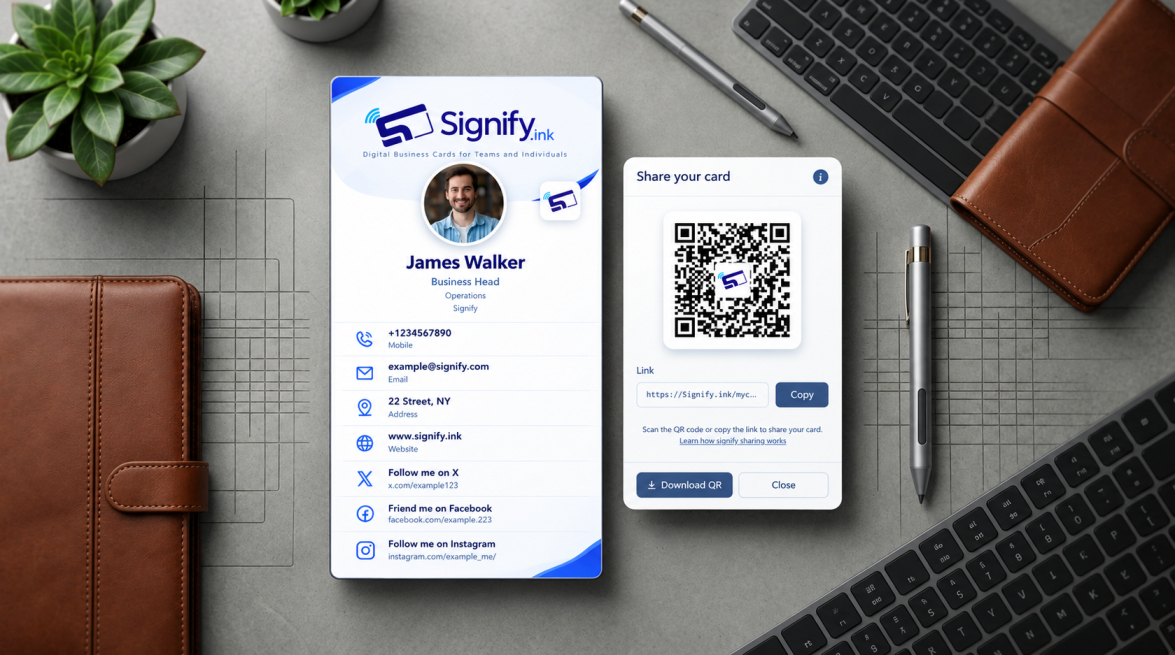
A digital business card is an online version of a professional business card that allows people to share their identity and contact information electronically.
Unlike a printed card, a digital business card can contain much more than basic contact details. Depending on the platform and configuration, it can include:
The result is less like a conventional card and more like a compact digital professional profile.
Why Traditional Business Cards Are No Longer Enough
Paper business cards are not inherently bad. They are inexpensive, familiar, easy to print, and still useful in many situations.
The problem is that they were designed for a world in which contact information was primarily stored and exchanged offline.
Modern professional relationships rarely work that way.
After receiving a paper card, the recipient may need to manually enter the information into their phone or CRM, search for the person's LinkedIn profile, visit the company website separately, or remember what was discussed during the meeting.
That creates friction.
A digital business card reduces that friction by connecting the introduction directly to the digital information that matters.
Paper Cards Are Static
If your phone number, job title, company website, or address changes, a printed card cannot update itself. You need to create a new version and distribute it again. A digital business card can be updated without requiring you to reprint and redistribute hundreds of cards.
Limited Space Restricts Your Professional Story
A paper card has limited physical space. A digital profile is not constrained by the dimensions of a piece of paper. You can provide additional information through links, sections, media, and calls to action without overwhelming the initial presentation.
The Follow-Up Often Happens Somewhere Else
A paper card begins a relationship but does not inherently provide a direct path to the next action. A digital business card can bring websites, social profiles, contact options, and other destinations together in one professional destination.
Cards Can Be Forgotten
Networking events can involve dozens or even hundreds of conversations. A physical card can easily end up in a wallet, notebook, desk drawer, or pile of other cards. Digital sharing gives the recipient an opportunity to immediately interact with your information while the conversation is still fresh.
How Digital Business Cards Work
The concept is simple: create your profile, choose your professional information, and share it through digital channels.
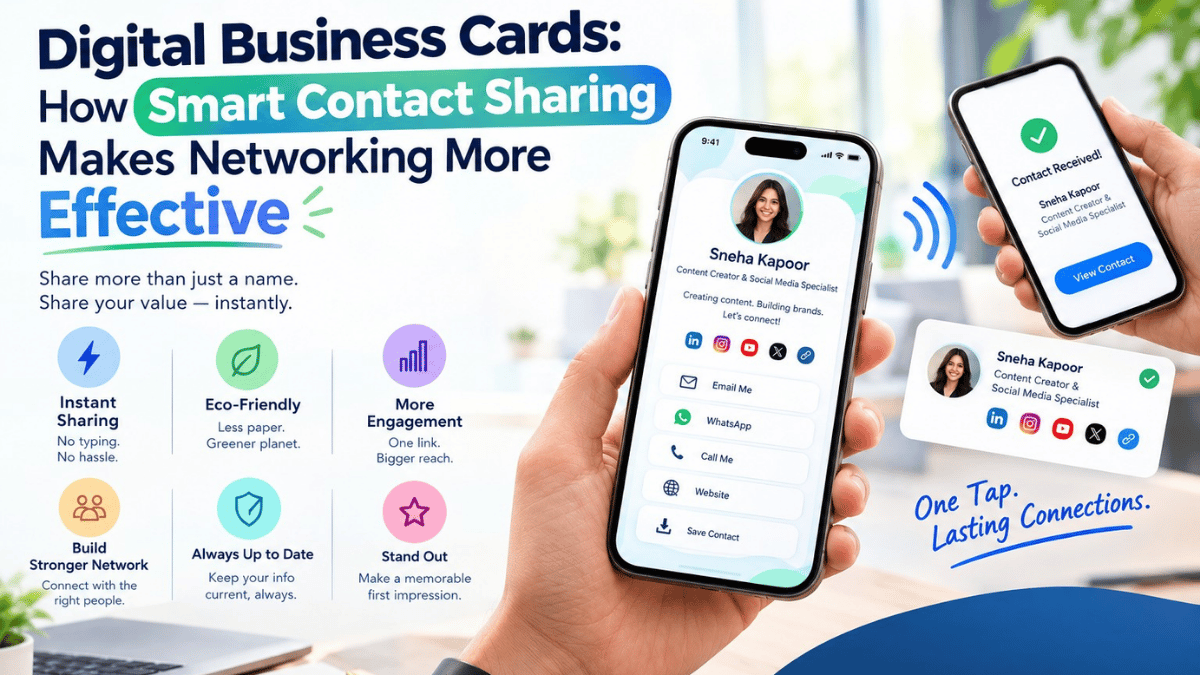
Depending on the sharing method and device, digital cards may also be shared through NFC-enabled experiences.
The recipient does not necessarily need to install a special application just to view a web-based digital business card. The experience can be designed around the smartphone and browser environment people already use every day.
The best networking technology is not necessarily the technology with the most features. It is the technology that removes friction without making the other person learn a complicated process.
QR Code Business Cards: Making Sharing Instant
QR codes have become a familiar part of everyday digital interactions. They can be used for menus, payments, event registrations, websites, authentication, product information, and many other purposes.
A QR code can also provide a convenient gateway to a digital business card.
This creates a more direct transition from meeting someone to connecting with someone.
NFC and Contactless Business Card Sharing
Near Field Communication
NFC allows compatible devices and accessories to exchange information over a short distance. For networking, this can create a highly convenient experience: a professional can use an NFC-enabled card or device to direct someone to their digital business card.
The Physical Object Becomes a Gateway
The physical card or accessory does not need to contain all of the professional information. Instead, it can act as the gateway to the digital profile. The physical object becomes a connection point, while the digital profile becomes the actual professional destination.
Digital Business Cards Are More Than Digital Contact Information
One common misconception is that a digital business card is simply a digital copy of a paper card. That understates its potential.
A well-designed digital business card can function as a professional landing page.
Traditional Card
John Smith
Sales Director
ABC Company
Email and phone number are provided as basic contact information.
Digital Business Card
- Save contact
- Email John
- Call John
- Visit ABC Company's website
- View John's LinkedIn profile
- Schedule a meeting
- Review a portfolio
- Watch a company video
- Explore services
- Read an important document
- Follow the company
- Submit an inquiry
The card becomes an interactive experience rather than simply a storage mechanism for contact details.
Build a Stronger Digital Professional Identity
Your business card is often one of the first representations of your professional identity. That makes presentation important.
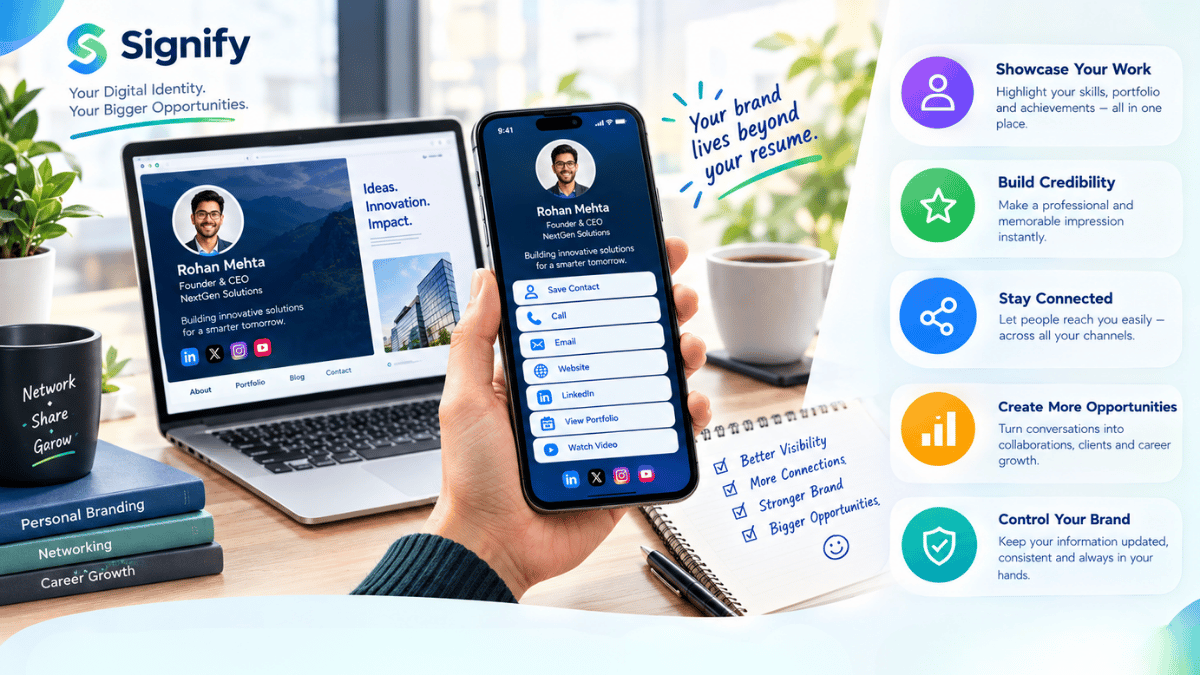
A digital business card gives professionals an opportunity to create a consistent identity around their name, position, company, brand, visual identity, professional description, digital presence, relevant links, and calls to action.
For individuals, this can help create a more polished personal brand. For companies, it can help create consistency across employees.
Professional branding is not only about logos and colors. It is also about consistency.
Digital Business Cards for Sales Professionals
Sales professionals depend heavily on relationships. A conversation at a trade show, networking event, client meeting, or industry conference may become the beginning of a long-term business relationship.
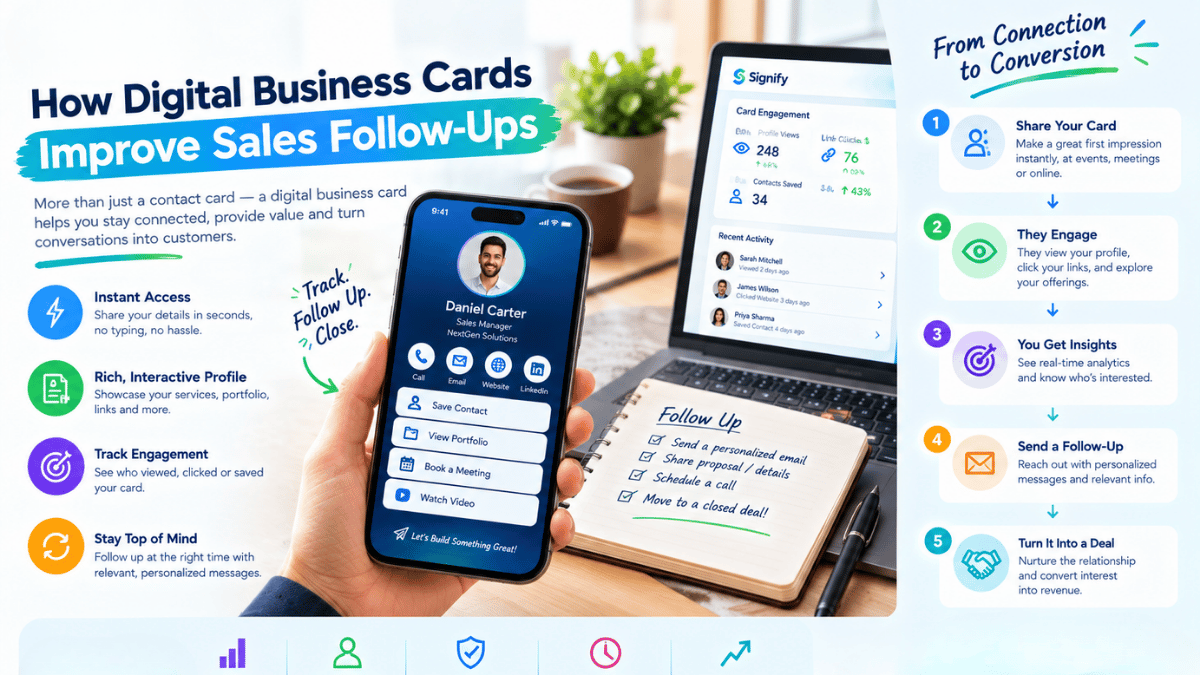
A digital business card can help create a smoother transition between the introduction and the follow-up.
One professional destination. Multiple relevant paths forward.
Digital Business Cards for Entrepreneurs and Founders
One Central Digital Identity
A founder may meet investors, customers, partners, employees, advisors, suppliers, and other entrepreneurs. Each conversation can have a different purpose.
A digital business card gives the founder a flexible professional profile that can connect different audiences to different parts of their online presence.
Useful Founder Destinations
- Company website
- Personal LinkedIn profile
- Company LinkedIn page
- Product website
- Demo booking link
- Investor information
- Media profile
- Contact options
- Social profiles
Digital Business Cards for Consultants and Freelancers
Consultants, freelancers, designers, engineers, developers, photographers, architects, marketers, and other independent professionals often need to demonstrate credibility quickly. Contact information alone may not be enough.
What do you do?
Clearly communicate your professional role and expertise.
What have you worked on?
Showcase projects, portfolio pieces, experience, or selected work.
How can I contact you?
Make contact options easy to find and use.
Where can I see your work?
Connect visitors directly to your portfolio or professional resources.
Can I schedule a conversation?
Provide a calendar or booking link when appropriate.
A Lightweight Introduction
The card can become a professional introduction that travels with every opportunity.
Digital Business Cards for Recruiters and Job Seekers
For Recruiters
Recruiting is another environment where digital identity can be useful. Recruiters meet candidates at career fairs, university events, conferences, industry gatherings, and professional networking events.
- Name and recruitment role
- Company information
- Career page
- Open positions
- LinkedIn profile
- Contact details
- Company website
For Job Seekers
Professionals looking for opportunities can create digital cards that connect directly to their portfolio, resume, LinkedIn profile, GitHub, personal website, or other relevant professional resources.
Digital Business Cards for Events and Conferences
Events are one of the strongest use cases for digital contact sharing. At a busy conference, professionals may meet dozens of people in a short period.
Meet someone.
Exchange cards.
Put the cards away.
Return to the office.
Sort through cards.
Search for people online.
Enter information.
Start follow-up.
Digital sharing can simplify the initial exchange and let networking continue without carrying a large stack of paper cards.
The Environmental Advantage of Going Digital
Digital transformation is not only about convenience. It can also reduce dependence on printed materials.
Traditional business cards require paper, printing, ink, packaging, transportation, and repeated production when information changes.
Digital business cards eliminate the need to print a new card every time a professional changes their information.
This can be particularly meaningful for organizations with large teams. If a company has hundreds of employees and regularly updates employee details, printed cards can become an ongoing administrative and material expense.
Digital tools should not be presented as automatically "zero impact"—digital infrastructure also consumes resources—but reducing unnecessary printing can be a practical part of a broader paper-reduction strategy.
Keep Your Contact Information Up to Date
One of the most useful characteristics of a digital business card is its ability to be updated.
Suppose a professional changes:
The link or QR code can continue pointing to the same digital profile while the information displayed on that profile changes.
One Link for Your Professional Information
Contact Details
Your contact information can live within the central profile.
Connect visitors directly to your professional social profile.
Portfolio
Give prospects a direct route to your work and projects.
Calendar
Make booking a conversation more convenient.
Company Website
Provide a direct connection to your business presence.
Social Profiles
Bring relevant digital channels together in one place.
"Can you send me your details?" → Simply share your digital business card.
Turn Networking Into a Two-Way Experience
Traditional networking is often one-directional. You give someone your card and hope they contact you.
Digital networking can create a more interactive experience. Depending on the platform's capabilities, a digital business card can provide opportunities to understand engagement with the profile.
Profile Views
Understand profile access when analytics are available.
Link Interactions
See which destinations receive engagement.
Popular Destinations
Identify resources that attract attention.
Engagement Patterns
Use activity as context for future conversations.
Card Activity
Gain visibility into digital profile interactions.
Responsible Interpretation
Analytics are signals, not guaranteed indicators of purchasing intent.
Digital Business Cards for Teams and Organizations
The value of digital business cards becomes even greater when multiple employees need to represent the same organization.
Consider a company with sales representatives, business development executives, consultants, project managers, account managers, recruiters, executives, and marketing employees.
If everyone creates their own digital profile independently, maintaining consistency can become difficult.
A centralized digital business card platform can help organizations manage employee profiles and maintain brand standards.
A balance between personal identity and corporate consistency.
Digital Business Card Management for Growing Companies
Growth creates a new challenge: information management.
When a business has five employees, updating profiles may be simple. When it has fifty, five hundred, or more, manual management becomes increasingly difficult.
A digital business card platform can help centralize the process.
Employee Cards
Create employee cards in a centralized environment.
Information Updates
Update employee information as roles and details change.
Brand Assets
Manage the assets that support consistent profiles.
Consistent Designs
Maintain a unified professional presentation.
Team Organization
Organize employee profiles and teams.
Central Dashboard
Manage profiles from a central dashboard.
Card Activity
Review available card activity and engagement.
Access Control
Control access where the platform supports it.
How to Design an Effective Digital Business Card
Creating a digital business card is easy. Creating a good digital business card requires more thought.
Start With the Essentials
Your card should immediately communicate: Who are you? What do you do? Which organization do you represent? How can someone contact you?
Use a Professional Photograph
For many professionals, a clear profile photograph helps make the digital profile more recognizable. Use an image that matches your professional context.
Add Your Company Branding
If the card represents a company, use the organization's visual identity consistently.
Prioritize Important Links
Do not overwhelm visitors with twenty unrelated links. Think about the actions that matter most: Contact, Website, LinkedIn, Portfolio, and Book a Meeting.
Include a Clear Call to Action
Examples include Save My Contact, Visit Our Website, Book a Meeting, View Portfolio, and Contact Me.
SEO and Digital Business Cards
A digital business card is not necessarily intended to replace a company's website or compete with search-optimized landing pages. Its role is different.
The digital card serves as a convenient professional identity and connection point.
For organizations, digital profiles can complement a broader digital presence by connecting users to SEO-optimized websites, product pages, service pages, portfolios, social profiles, and other relevant destinations.
The strongest approach is not to make the digital card responsible for everything. Instead, use it as part of a connected digital ecosystem.
Digital Identity Is Becoming More Important
Networking used to begin with a handshake and a paper card. Today, it often begins with a smartphone.
A person may meet you physically and then immediately search for your company online. They may look at your LinkedIn profile, visit your website, review your work, or search for reviews or recommendations.
That means your offline introduction and online identity are increasingly connected.
A digital business card helps bridge those two worlds. It gives professionals a deliberate digital destination rather than leaving prospects to search for information independently.
The Role of Signify in Modern Networking
Your Business Card Should Do More
Signify is built around the idea that a business card should do more than display contact information. It should help professionals present their identity digitally and make sharing simple.
With Signify, users can create a digital business card that brings professional information together in one place and share their profile through digital methods such as a link or QR code.
For businesses, organizations can use digital cards to establish a consistent professional identity across their teams while giving employees a convenient way to connect with customers, prospects, partners, and other professionals.
Digital Business Cards vs. Traditional Business Cards
The difference is not simply paper versus digital. It is static versus dynamic.
| Traditional Business Card | Digital Business Card |
|---|---|
| Printed information | Digital information |
| Limited physical space | Flexible digital profile |
| Difficult to update | Can be updated digitally |
| Shared physically | Shared through links, QR codes, and compatible contactless methods |
| Limited interaction | Can include interactive links and actions |
| Little visibility after sharing | May provide analytics depending on platform |
| Requires reprinting for changes | Updates can be made without reprinting |
| Primarily contact information | Contact information plus professional resources |
| Individual physical cards | Can be centrally managed for teams |
Neither approach needs to be viewed as completely incompatible with the other. A business can continue using physical materials while adding a digital business card to create a more connected experience.
When Should You Use a Digital Business Card?
Attending a Conference
Share your profile without carrying a large supply of printed cards.
Meeting a New Client
Provide contact information along with your company website and relevant resources.
Joining a Networking Event
Create a fast and memorable way for attendees to connect with you.
Giving a Presentation
Place a QR code on your presentation so attendees can access your professional profile.
Meeting Potential Partners
Share company information and relevant links from one destination.
Building a Personal Brand
Create a professional online identity that connects your various digital channels.
Managing a Sales Team
Provide employees with consistent digital profiles that support business development.
Recruiting
Make it easier for candidates and professional contacts to access relevant career information.
Best Practices for Digital Business Card Networking
Technology can make sharing easier, but good networking still depends on human interaction.
Introduce Yourself Before Sharing
Do not immediately present a QR code without context. Have a genuine conversation first. The card should follow the connection.
Keep the Profile Relevant
Only include information that helps the recipient understand you and take the next appropriate action.
Make the Card Mobile-Friendly
Most people will access your digital business card from a smartphone. The experience should therefore be clear, responsive, and easy to navigate.
Keep Information Current
An outdated digital profile can undermine credibility. Review your information regularly.
Connect Your Most Important Digital Channels
Choose the websites and profiles that genuinely support your professional goals.
Use Consistent Branding
For organizations, ensure that employee profiles align with the company's brand.
Use Analytics Responsibly
Analytics can provide useful engagement information, but they should be interpreted as signals rather than guaranteed indicators of purchasing intent.
Digital Business Cards and the Future of Networking
Professional networking is becoming increasingly digital, but the fundamental objective has not changed.
Meet the Right People
People still want to meet the right people.
Build Trust
People still want to build trust.
Exchange Information
People still want to exchange information.
Create Meaningful Conversations
People still want meaningful conversations.
A paper business card was never designed for that journey. A digital business card is.
From a Business Card to a Digital Relationship
The most important shift is conceptual.
A business card should not be viewed simply as something you hand to someone. It is the beginning of a relationship.
The card should make it easy for another person to remember who you are, understand what you do, find your company, contact you, and continue the conversation.
How easily can people connect with us?
Can prospects find the information they need?
Is our professional identity consistent?
Can our team share information efficiently?
Are we making the next step easier?
Those questions move networking away from quantity and toward quality.
Why Smart Contact Sharing Matters
The biggest advantage of a digital business card is not that it eliminates paper. It is that it reduces friction.
Every unnecessary step between meeting someone and connecting with them creates an opportunity for the relationship to lose momentum.
Traditional Journey
Simpler Digital Journey
Technology cannot replace genuine communication, trust, and follow-up. But technology can make it easier to begin.
Frequently Asked Questions About Digital Business Cards
What is a digital business card?
A digital business card is an online professional profile containing contact information, professional details, links, social profiles, and other relevant resources. It can be shared electronically instead of relying only on a printed business card.
How do I share a digital business card?
Digital business cards can commonly be shared using a direct link, QR code, or compatible NFC-based method. The recipient can open the digital profile on a smartphone or other supported device.
Do digital business cards replace paper business cards?
They can replace paper cards for many networking situations, but businesses can also use both. A QR code on printed materials, for example, can connect a physical card or brochure to a digital business card.
Can I update a digital business card?
Yes. One of the major advantages of a digital business card is that information can be updated digitally, depending on the platform. Changes to contact information or professional details do not necessarily require reprinting cards.
Can a digital business card include social media links?
Yes. A digital business card can connect visitors to professional and social profiles such as LinkedIn and other relevant online destinations.
Are digital business cards useful for businesses?
Yes. Businesses can use digital business cards to give employees consistent professional profiles, simplify contact sharing, connect prospects with company resources, and support modern networking activities.
Can digital business cards support personal branding?
Yes. A digital business card can combine your professional information, profile image, portfolio, website, social profiles, and other resources into one branded digital identity.
Are digital business cards environmentally friendly?
Digital business cards can reduce the need for repeated printing and disposal of paper cards. However, digital services also use physical infrastructure and energy, so they should be considered one part of a broader sustainability strategy rather than automatically described as impact-free.
Make Every Introduction More Connected With Signify
Your business card is no longer limited to a piece of paper. It can be your professional identity. It can connect people to your website, social profiles, portfolio, company, services, and contact information.
It can be updated as your career or business evolves. It can be shared at conferences, meetings, networking events, presentations, and everyday professional conversations.
Signify brings this concept into a practical digital experience, helping individuals and organizations create and share professional digital identities without depending entirely on traditional printed cards.
The future of networking is not simply about collecting more cards. It is about creating better connections.
Explore Signify →Conclusion
The traditional business card has served professionals for generations, but the way people communicate, discover businesses, and build professional relationships has changed dramatically.
A modern professional identity needs to work across both physical and digital environments.
Digital business cards provide a practical way to make that transition. They offer a flexible alternative to static contact information, allowing professionals to share their details through digital links, QR codes, and compatible contactless technologies while connecting recipients to websites, social profiles, portfolios, calendars, and other resources.
For individuals, digital cards can strengthen professional presentation and personal branding.
For sales teams, they can simplify contact sharing and create a more connected follow-up experience.
For companies, they can support consistent brand representation and centralized digital identity management.
For entrepreneurs and freelancers, they can provide a compact destination for presenting professional information and work.
Most importantly, digital business cards make networking fit more naturally into the digital world people already use.
The business card is evolving.
The next generation of networking is not about handing someone a piece of paper and hoping they remember you.
It is about giving them a simple, professional way to connect with you—and making it easy to continue the relationship.
That is the real value of a digital business card.
That is what Signify is built to help you do.