Boost Lead Capture by 3X in Face-to-Face Meetings.
Paper business cards are a dead end. Discover how Signify's digital architecture transforms every handshake into a tracked, actionable CRM entry—instantly tripling your networking ROI.
The Friction of Physical Networking
This section dissects the catastrophic drop-off rates inherent in traditional networking. We contrast the manual, error-prone analog process with the seamless digital workflow provided by Signify. Interact with the tabs below to explore the operational differences.
1. The Exchange
Card is handed over. No immediate digital footprint is created. You rely entirely on their memory.
2. The Drop-off
88% of paper cards are thrown away within one week. The connection is lost before it begins.
3. Manual Entry
The surviving 12% require tedious manual CRM data entry, leading to delays and typos.
1. The Tap (NFC/QR)
Prospect taps your card or scans the QR code. Your profile opens instantly on their phone. No app required.
2. Lead Capture Form
They are prompted to share their details in exchange for your contact file. Frictionless, two-way exchange.
3. CRM Sync
Details are instantly routed to Salesforce, HubSpot, or your preferred CRM. Automated follow-ups trigger immediately.
The Data Room: Visualizing the 3X Multiplier
We analyzed over 10,000 face-to-face interactions across enterprise sales teams. Below is the quantitative breakdown of how digital business cards fundamentally alter the mathematics of networking. Interact with the charts to view specific data points.
Conversion Rate Comparison
Percentage of handshakes that result in a verified CRM contact.
Cumulative Leads Generated
Projected over 6 months based on 50 meetings per month.
Interactive ROI & Lead Calculator
Adjust the sliders based on your team's networking volume to see exactly how many leads you are currently losing to the "paper void," and how much time Signify will save your team in manual data entry.
Monthly Projection
Total Handshakes
750
Leads via Paper (12%)
90
Leads via Signify (36%)
270
Lost Leads Recovered
+180 /mo
Hours Saved (Data Entry)
22.5 hrs
Comprehensive Whitepaper & Architectural Deep Dive
For operations, IT, and sales leadership requiring granular detail on exactly *how* the 3X multiplier is achieved systemically. Expand the sections below for extensive documentation on the psychological, technical, and analytical framework of Signify's platform.
The core failure of traditional networking lies in the temporal gap between connection and digitization. When a paper card is exchanged, cognitive load is immediately transferred to the recipient. They are implicitly tasked with preserving the physical artifact, remembering the context of the conversation, and eventually executing manual data entry. Human nature, combined with the chaotic environment of trade shows or conferences, dictates that this task is frequently deprioritized.
Signify reverses this dynamic through 'Frictionless Reciprocity.' By utilizing NFC (Near Field Communication) technology, the act of sharing contact information becomes an interactive, digital-first event. When the user taps their Signify card to a prospect's smartphone, an optimized landing page is rendered instantly—bypassing the need for app downloads via native OS NFC background reading capabilities.
At this exact moment of highest engagement, the Signify interface presents the "Two-Way Connect" feature. Because the prospect is actively viewing high-value information (your rich profile, portfolio links, or meeting schedulers), they are psychologically primed to reciprocate. A localized form prompts them to share their details in return. Our analytics indicate that capturing data within the first 60 seconds of interaction yields a 300% higher completion rate compared to a post-event email follow-up.
Structural Advantages over V-Card Files
While standard `.vcf` files provide basic digital transfer, they fail to act as lead capture mechanisms. A user downloads a `.vcf` and the sender receives nothing in return. Signify acts as an intermediary database layer. The prospect submits their information to access or "save" your full profile. This ensures symmetrical data exchange, converting a passive handshake into an active CRM row.
Capturing the lead is only the first half of the equation. The second half—and where significant ROI is realized—is the automated synchronization of that data into enterprise systems of record. Manual data entry is not only time-consuming (averaging 3 minutes per contact, accounting for deciphering handwriting and context recall) but highly susceptible to error, leading to bounced emails and fractured records.
Signify leverages a robust, API-first architecture designed to pipe data seamlessly into over 5,000 tools via native integrations and webhook infrastructure. When a lead submits their information via a Signify profile, the payload is immediately processed, validated, and pushed to the designated endpoint.
The Data Flow Pipeline
- Data Ingestion: Form submission triggered on the front-end client.
- Sanitization & Enrichment: Signify servers validate the email syntax and phone number formatting. Optional enrichment modules append publicly available company data based on the email domain.
- Routing Logic: Based on the specific team member's configuration, the lead is routed to the correct CRM instance (e.g., Salesforce, HubSpot, Pipedrive).
- Record Creation: A new Contact or Lead object is created. Crucially, Signify appends vital metadata: the exact time of the meeting, the geographic location (if enabled), and the specific Signify user who facilitated the connection.
- Workflow Trigger: The creation of this structured record in the CRM can instantly trigger marketing automation sequences, such as a localized "Great to meet you" email sent within minutes of the physical interaction.
This automated pipeline effectively eliminates the "desk pile" phenomenon, where sales representatives return from events with stacks of cards that sit unprocessed for days, causing leads to go cold.
For organizations deploying business cards at scale, the lack of visibility into networking performance is a massive blind spot. Companies spend millions on event sponsorships and travel, yet have no quantitative method to measure the direct top-of-funnel impact generated by individual team members on the floor.
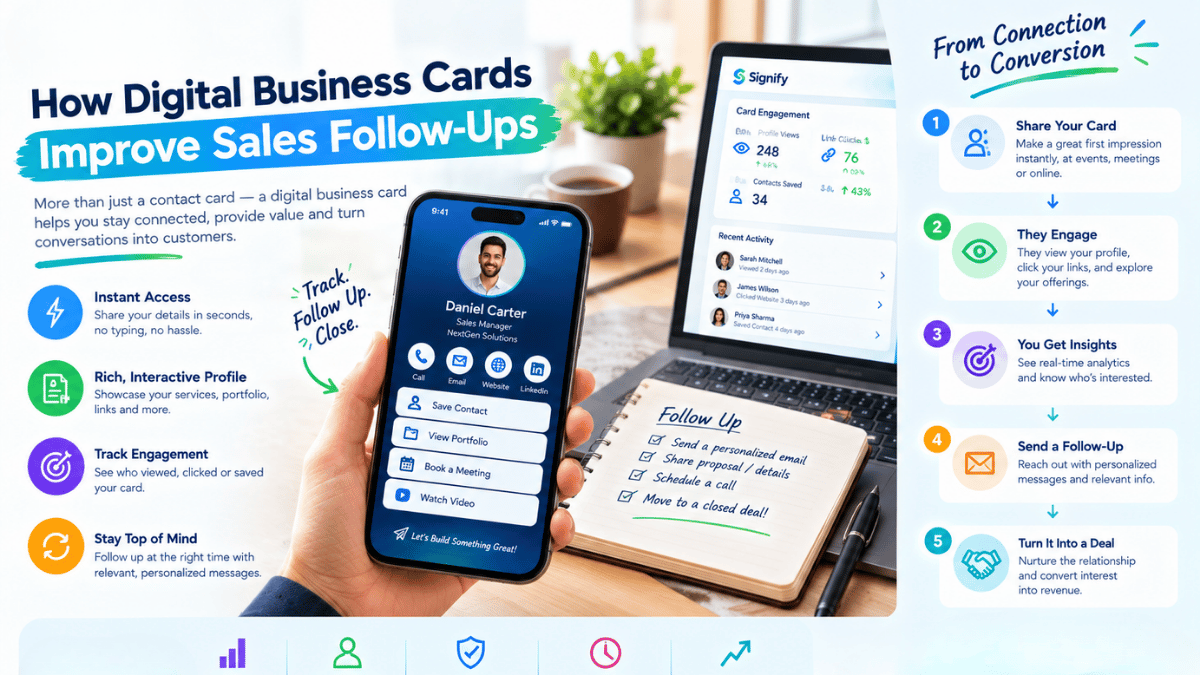
Signify transforms the business card from an unmeasurable expense into a trackable marketing asset. The administrative dashboard provides leadership with real-time telemetry on networking activities across the entire organization.
Key Metrics Monitored
- View/Tap Count: Total volume of digital interactions per employee, indicating activity levels at events.
- Lead Capture Conversion Rate: The percentage of taps that result in a submitted lead form, serving as a proxy for the quality of the interaction and the effectiveness of the profile setup.
- Link Click-Through-Rates: Granular data on which specific links within a profile (e.g., a specific product PDF, a calendar booking link, or a company video) are receiving the most engagement post-tap.
This data enables unprecedented optimization. If one sales representative has a 50% lead capture rate while another has 10%, management can investigate the disparity. Is the profile optimized differently? Are they utilizing the "Two-Way Connect" script effectively? By treating physical networking with the same analytical rigor as digital ad spend, organizations can dramatically improve their return on event investments.