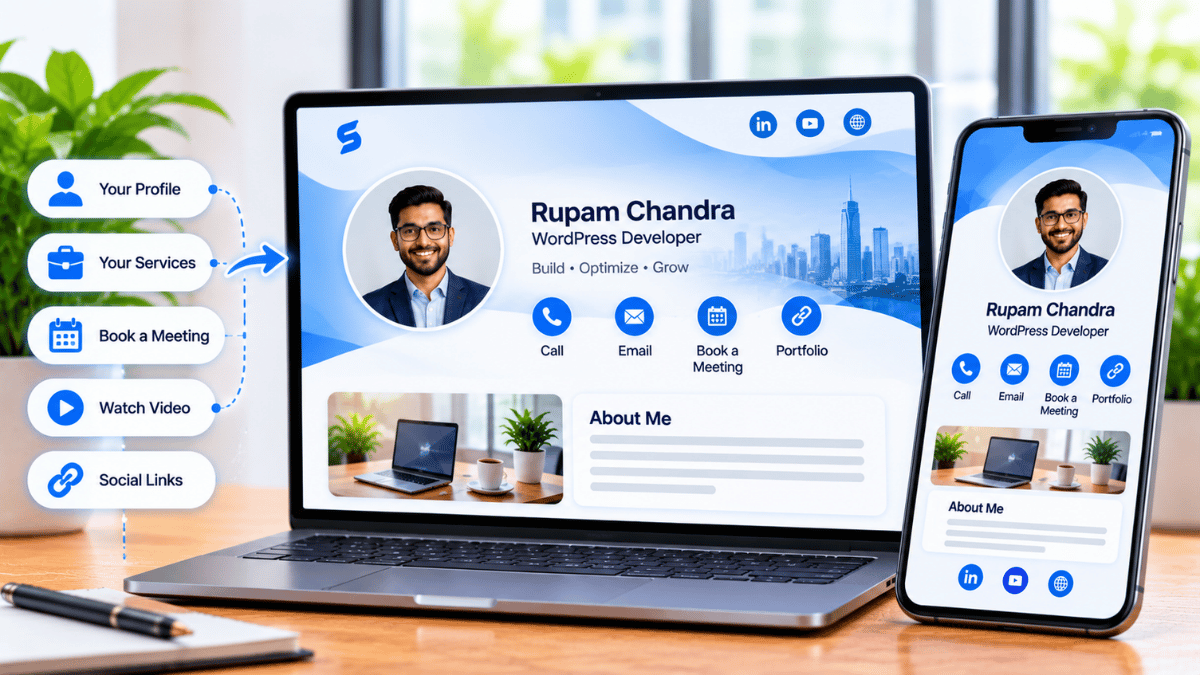
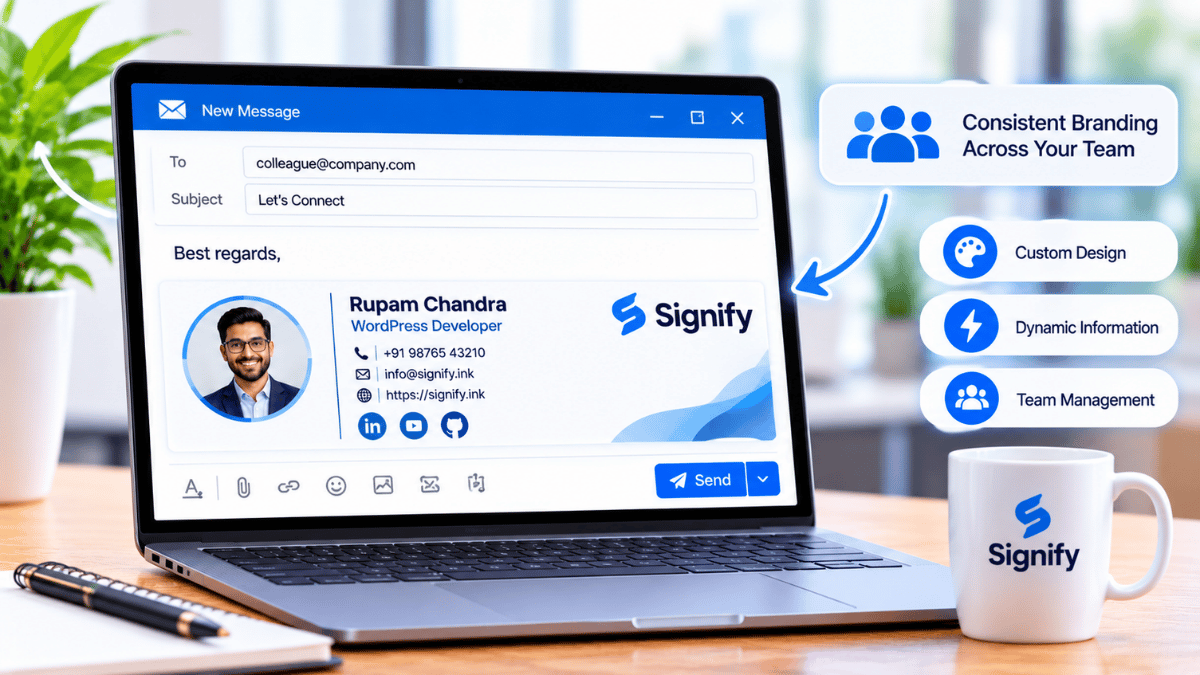
Signify.ink

A founder’s professional identity changes faster than almost anyone else’s. In the first two years of a company, the same person may be “Founder”, then “CEO”, then “CEO & Co-Founder”, then “Founder & CTO” after a pivot, then “CEO” again after a role reshuffle. The company name might change once. The office address might change three times. Each of these transitions is a paper card that no longer matches the person handing it over. For a founder, a static card is not just a small annoyance — it is a brand problem that compounds across every investor meeting, every conference, and every email that goes out with a signature attached.
This is why the founder case for a Signify digital business card is different from the general case. It is not primarily about sustainability or analytics. It is about the fact that a founder’s identity is in motion, and a card that cannot move with it is a card that quietly goes wrong. This guide is written for founders and early-stage teams — it covers the specific costs of paper at that stage, what a live card actually changes, and what to look for before committing the team to a platform.
- A founder’s title, company, and contact details change more often than a printed card can track — a live profile updates in one place.
- Roughly 88% of paper cards are thrown away within a week, cited by the American Bar Association. For an investor meeting, that number is a lost follow-up.
- The three founder-relevant costs are reprint cycles, follow-up failures, and brand inconsistency across the team.
- Team deployment through Signify Teams is where a startup gets the biggest return — one template, one brand, one admin view, no per-office reprint.
Why founders face a specific card problem
Most professionals change roles every three to five years. A founder might change the title on their card three times in eighteen months — sometimes because the company has grown and the role has shifted, sometimes because the product has pivoted and the positioning has changed, sometimes because a co-founder has joined and the title needs to reflect a new division of labour. Every one of those transitions is a card that needs to be reprinted, redistributed, and re-internalised by the people who have saved the old version.
The problem is not just the reprint cost. It is the version drift. A founder who has handed out the “Founder & CEO” version of their card at a conference in March and the “CEO & Co-Founder” version at a demo day in September now has two groups of people holding two different cards. When one of them reaches out in December, the founder has no way to know which version that person is holding, and no way to correct it. The mismatch is small in any given conversation, but across a network of hundreds of investors, partners, and early customers it compounds into a branding problem that is harder to fix than a reprint.
That is the specific founder case for a live online business card: not the abstract benefit of being modern, but the concrete benefit of having one canonical version of your professional identity that updates in place across everyone who has ever saved it.
The three costs of paper for a founder
The general case against paper cards is well known — they are wasteful, they go stale, they end up in a drawer. But for a founder, three of those costs hit harder than they do for a salaried professional in a large company.
Reprint cycles compound
A large company can absorb the cost of a reprint after a rebrand because the cost is spread across hundreds of employees and can be batched into a single order. A startup cannot. Every reprint is a line item that competes with headcount, tooling, and marketing. A 12-person team that reprints cards every six months across three role changes is spending real money on a disposable object. The Signify pricing page reflects the difference: a fixed subscription replaces a recurring print cost.
Follow-up failures are expensive at the earliest stage
For a founder, a single follow-up that lands is worth more than dozens of business cards handed out. The Harvard Business Review has documented the pattern across industries: people who receive something valuable in a networking conversation often never hear from the person who gave it again. At a founder’s stage, that pattern is not a curiosity — it is a lost investor, a lost customer, a lost hire. The send-a-card flow is the specific mechanism that removes the friction from that follow-up.
Brand inconsistency is a credibility problem
A startup’s brand is often its strongest asset in the first two years. If the founder’s card, the co-founder’s card, the first sales hire’s card, and the first engineer’s card all look different, that inconsistency is a signal to investors and partners that the company is not yet operating as a coherent organisation. Signify Teams provides shared brand templates so the visual identity is consistent across the team without flattening each person’s individual card.
What a live card actually changes
The case for a founder is not “digital cards are better in every way”. It is narrower: four specific capabilities matter for a company whose identity is changing quickly, and paper cannot deliver any of them.
Updates propagate to everyone
Change your title once and every recipient who saved the link sees the new version. The version drift problem described above disappears — there is only ever one current version in circulation.
Analytics on investor engagement
Views, saves, and link clicks. For a founder, knowing whether an investor actually opened the deck linked on the card — and when — is a real signal. The online business card page covers what the tracking includes.
CRM capture from a shared surface
Contacts captured through the card can route into a CRM rather than a personal address book. For an early-stage startup, that means leads stay with the company if a team member leaves. The leads integration page covers the Zoho CRM sync.
Two of those — updates in place and CRM capture — matter disproportionately for a founder. Updates in place because the founder’s identity is the most volatile one in the company. CRM capture because the earliest customer and investor relationships are the ones the company cannot afford to have walking out the door with a departing employee.
The investor conversation
Investor meetings are the highest-stakes networking moments a founder has, and they illustrate why the small frictions of paper cards matter. An investor meets dozens of founders in a month. The card they are handed is one of dozens that week. Whether that card survives to a follow-up depends on whether the investor can save the contact with one tap, and whether the founder’s details are still accurate when the investor opens the saved card three weeks later.
A digital card improves both. The card can be saved with one tap, and the profile updates in place — so a founder who changes their title after closing a round does not need to correct every investor who saved the old version. The card also carries a link to the pitch deck, the company site, and the founder’s calendar — which is the practical surface an investor actually needs, not just a phone number.
The founder-specific practices that make this work:
- Put the pitch deck behind a tracked link on the card. If an investor saves the card and opens the deck, the analytics on the card will show the click.
- Keep the card current through fundraising cycles. The title and the company positioning change during a round — the card should reflect those changes without a reprint.
- Use the send-a-card flow for the follow-up. A card sent by email with a VCF attached is a card the investor can save in one tap, three minutes after the meeting ends.
Paper vs digital, for a founder
The comparison table that matters for a founder is different from the general one. It is less about “modern vs traditional” and more about which costs a founder actually pays.
| Dimension | Paper card | Digital card |
|---|---|---|
| Title and company changes | Reprint required; old versions stay in circulation | Update once; every saved link reflects the new version |
| Cost after a rebrand | A new print order per team member | Template updated once across the team |
| Follow-up speed | Recipient has to type the details, or the card is lost | One-tap VCF save, and the send-a-card flow delivers by email |
| Investor engagement signal | None — a card in a drawer is invisible | Views, saves, and link clicks on the card |
| Team consistency | Each card printed independently; brand drift | Signify Teams shared templates across the team |
| Contact ownership if someone leaves | Cards stay in circulation after the employee leaves | Card deactivated centrally through Teams |
The team version: what changes at 10 people
A solo founder can get by with a free card and a link. The team version is where the operational value becomes visible, and it is where the reprint cost that paper cards impose on a startup is easiest to see.
At ten people, the average startup has already reordered business cards twice — once after the initial batch ran out, and once after a title change or rebrand. Each order takes time to arrive, and each order is out of date for someone by the time it does. The Signify Teams model removes the reorder cycle entirely:
-
One admin dashboard for seats. Add a new hire to the team and their card is live on day one, without a printing delay. Remove a departing employee and their card is deactivated centrally rather than left in circulation.
-
Shared brand templates. When the company rebrands — and it will — the template updates once and every card reflects the change. No per-office reprint, no version drift across team members.
-
Central deactivation as a security control. A departing employee’s card stops resolving. That is a control a paper card cannot provide at all — the printed card that was handed out last month is still in circulation, and there is nothing the company can do about it.
-
CRM sync across the team. Contacts captured through any team member’s card can route into the company CRM through the leads integration, so leads become a company asset rather than an individual’s address book.
-
Predictable subscription cost. A fixed per-seat cost replaces a recurring reprint cost. For a founder tracking burn, that predictability matters more than the absolute number. The pricing page has the current seat tiers.
Sources: American Bar Association (10 billion cards, 88% discard); UPrinting (88%).
What to check before choosing a provider
A founder evaluating a digital card platform should apply the same tests they would apply to any tool the team will depend on: does it fit the workflow, does it stay current, does it survive the team growing, and does it have a plan for the day someone leaves.
-
Recipients do not need an app. An investor or customer should be able to open the card in a browser. If they need to install something, the card will not be saved. This is the single most important criterion.
-
Updates happen in place. The link you shared at a demo day should still resolve to your current profile six months later. The card is not a hosted PDF; it is a live profile.
-
A team plan exists and is usable. If the platform does not have a plan for a ten-person team with shared templates and central deactivation, it will stop fitting the business the day you hire the second salesperson.
-
Multiple sharing modes. A QR code on a slide, an NFC tap in person, a link in a follow-up email. A provider that only offers one will not fit every situation.
-
Field-level privacy controls. The founder should be able to share a role and a portfolio without exposing a personal mobile number. Field-level visibility is available on the Pro and Teams plans.
-
A verifiable security posture. Encryption in transit and at rest, 2FA, and named compliance frameworks. The security policy page and the Consac knowledgebase are where to check.
One honest caveat: a digital card does not replace the in-person handshake or the warm introduction. It removes the friction from what happens after — the follow-up, the reprint, the version drift. A founder who meets nobody still has no pipeline, regardless of the card. But for a founder who is meeting a lot of people and cannot keep up with the card, a live profile removes a specific, real cost that paper imposes on early-stage companies more heavily than on anyone else.
Frequently asked questions
Why does a founder need a digital business card specifically?
Because a founder’s title, company, and contact details change more often than a printed card can track. Each transition — a promotion, a pivot, a rebrand, a funding round — makes the previously printed cards wrong. A live profile updates in place, so everyone who saved the link sees the current version.
Is a digital card worth it for a solo founder?
Yes, though the case is simpler than for a team. A single live profile removes the reprint cost after a title change and gives the founder an analytics signal on investor and customer engagement. The free tier covers the basics; the Create a Card flow takes a few minutes to set up.
When does a team plan make sense?
Once the company has three or more people regularly meeting investors, customers, or partners. Below that, a per-individual plan is fine. Above it, Signify Teams gives you shared templates, central seat management, CRM sync, and central deactivation for departing employees — which a per-individual setup does not.
Do investors need the Signify app to view a founder’s card?
No. The card opens in a browser, and the investor can save the contact as a VCF file without downloading anything. The send-a-card flow adds the VCF directly to the follow-up email so the investor can save the contact in one tap after the meeting.
Is the “88% of business cards are thrown away” statistic reliable?
It is the most widely cited figure in the category and is consistently traced to a 2017 Statistic Brain study. It is cited by the American Bar Association and by UPrinting. As with any single-source survey, the exact number should be treated as directional rather than precise.
How does Signify handle a departing team member?
On Signify Teams, an administrator can deactivate a departing employee’s card centrally. The link in a recipient’s history stops resolving to a live profile. That is a control a paper card cannot provide — the printed card that was handed out last month stays in circulation.
Can a founder share different information with different audiences?
Yes, within the limits of the card’s design. Field-level visibility controls on the Pro and Teams plans let you decide which contact details are public. The card itself is a single profile — if you want genuinely separate cards for different contexts (say, investor-facing and customer-facing), you can create multiple cards on the same account.
How do I get started?
Open Create a Card in Signify to set up an individual card, or visit the Signify Teams page to set up a team account. Share the card by link, QR code, or NFC tap, and route the follow-up through the send-a-card flow.
One card that moves with the company
Update your title once, and every investor, partner, and customer who saved the link sees the change — no reprint, no version drift.
Create your Signify card