 Signify.ink

Startup founders have a specific networking problem that most professionals don’t face: every conversation could be a customer, a hire, an investor, or a partner, and each of those audiences needs a different version of you. You meet dozens of people per month across pitch events, demo days, coffees, and conferences, and the follow-up is where most of the value either happens or evaporates. A Signify digital business card is built for that reality. It shares in one tap, carries the version of you that matters for each context, updates when your pitch changes, and gives you data on who actually engaged — which is the difference between networking that feels productive and networking that measurably is.
This guide is written specifically for founders. It is not a general introduction to digital business cards — the digital business card page covers that. It is a founder-focused walkthrough of where paper cards fail, what a working digital setup actually looks like, and the small set of habits that make the difference between a card that gets scanned and a card that gets saved.
Why paper cards fail founders
The traditional case against paper cards is well-documented across the industry. Roughly 88% of paper business cards are discarded within a week — an industry estimate that has circulated for years, though the original primary source is not well documented, so treat it as directional rather than precise. The industry-wide figure for trees consumed by paper card production is approximately 7.2 million annually, and global annual print volume sits around 10 billion cards. Those numbers describe a format that spends significant resources producing something most recipients throw away.
For founders, the failure is more specific and more expensive. Three things happen with paper cards at every event, and each one costs a founder something they cannot easily replace.
1. The follow-up depends on manual data entry
When you hand a paper card to an investor at a demo day, the follow-up requires them to open their phone, create a new contact, type in the details, and remember the context of the conversation. Most won’t. The ones who do will do it hours or days later, when the enthusiasm has cooled. A digital card removes this step — the recipient saves the contact with one tap, at the moment of meeting, and the profile carries the context (photo, role, current pitch) automatically.
2. The card goes stale the moment you change something
Founders change things constantly. New product launches, new positioning, new website, new deck, new team members. A printed card locked to one version of the pitch is out of date before the box is half-consumed. A Signify card updates once, everywhere — a change to your title, your company description, or your links propagates across every saved copy automatically.
3. You never learn which events produced anything
A founder who attends ten events a year has no idea which five produced pipeline and which five were a waste of travel budget, unless they track it manually. A digital card reports on views, saves, and link clicks — so the founder can see which events produced engagement, and can decide next year’s event calendar based on evidence rather than instinct.
Note on the figures above: the 10 billion and 7.2 million figures are widely cited industry estimates (originally surfaced via Statistic Brain and IBISWorld data aggregation, then repeated across the industry). The 88% figure is an industry estimate without a single primary source. These numbers are directional; the specific figures should not be quoted as precise.
The cognitive limits on founder networks
Founders often assume that the more people they meet, the larger their effective network becomes. Behavioral research says otherwise. British anthropologist Robin Dunbar established through cross-species comparisons that humans can maintain roughly 150 stable social relationships — the people you know well enough to place in your social world. Anyone beyond that threshold is a stored name, not a maintained relationship. The Wikipedia entry on Dunbar’s number has the fuller history and the research lineage.
For a founder, the practical consequence is that networking is not a quantity problem. Meeting 200 people at a conference does not produce 200 relationships — it produces 200 stored names and, if the founder is diligent, perhaps 20 follow-ups that actually happen. The leverage is not in collecting more contacts. It is in converting the contacts the founder already meets into maintained relationships within the ~150 threshold.
Sociologist Mark Granovetter’s 1973 paper, “The Strength of Weak Ties”, adds a second insight that founders find especially useful: opportunities flow more reliably through moderate weak ties than through either strong ties or very weak ties. Strong ties carry redundant information (your close network already knows what you know). Very weak ties lack the trust required for an actual introduction. The sweet spot is the layer of professionals you know well enough to reach out to, but not so well that they are already inside your information bubble. Building and maintaining that middle layer is where networking actually produces results.
Together, these two findings reframe what a founder’s networking should optimize for: not the number of introductions made, but the quality of follow-through with the contacts that fall inside the maintainable range. A working digital card is what makes that follow-through feasible at scale.
What a digital card actually does
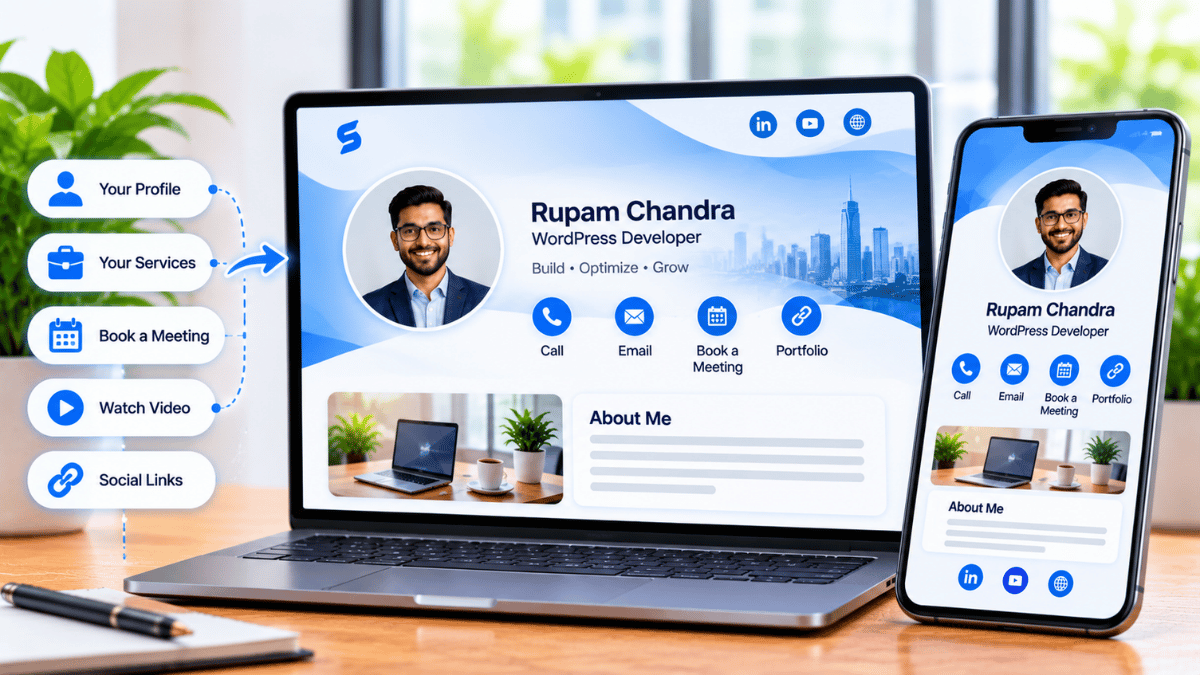
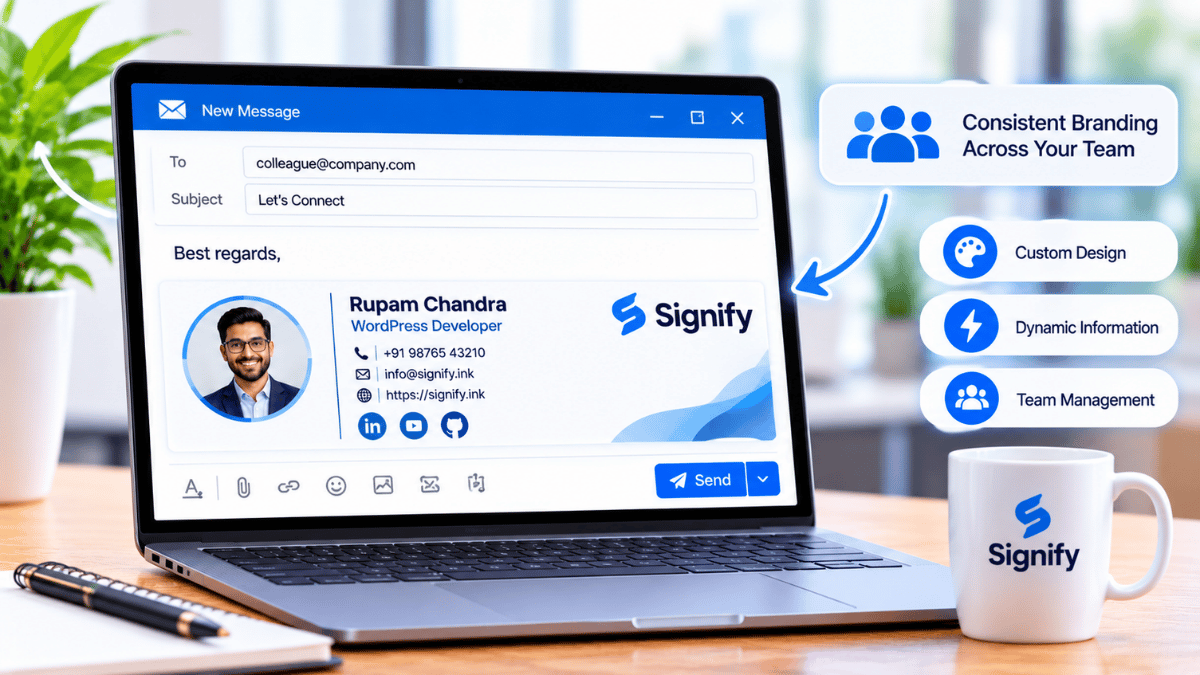
A Signify digital business card replaces the paper card with a browser-hosted profile. It can be shared four ways — NFC tap, QR code, direct link, and email signature — and the recipient never has to install an app or create an account. The profile opens in their browser and can be saved with one tap.
One-tap capture
The recipient saves your contact at the moment of meeting, without manual entry. This is the biggest single change in follow-through rates.
Updates everywhere
When you change your pitch, your title, or your links, the change propagates across every saved copy. No reprints. No stale cards in circulation.
Carries your actual pitch
Instead of a name and phone number, your card carries your deck, your calendar booking link, your LinkedIn, and any other context the founder needs the recipient to see.
Measures engagement
Views, saves, and link clicks per card tell you which events produced interest. The digital card page covers the analytics.
Eliminates print cycles
No print run, no reprint on every rebrand or role change, no boxes of outdated cards in a drawer. The sustainability case is straightforward.
Flows into the CRM
Contacts captured at events route into Zoho CRM automatically, so the pipeline reflects reality instead of whatever the founder remembered to enter.
Founders need more than one card
A founder is rarely just one thing. In the first two years of a company, the same person is often the CEO, the salesperson, the recruiter, and the business development lead — sometimes in the same week. Each of those audiences needs a different version of the pitch, and a paper card cannot carry all of them at once.
A digital card can. Signify Teams supports multiple cards per account, so a founder can maintain one card optimized for investor conversations (with a deck link and a data room link), one for sales conversations (with a pricing link and a booking calendar), and one for recruiting conversations (with a careers page and a hiring manager link). The founder switches between them depending on the moment — and each version stays current automatically because the underlying profile updates propagate.
For most early-stage founders, this is more valuable than it sounds. A generic “founder” card that tries to serve all four audiences at once usually serves none of them well. A set of two or three context-specific cards, each tuned to one audience, converts at measurably higher rates because the recipient sees a profile that matches the conversation they just had.
Paper vs. digital, compared
The comparison is not “which is more modern” — it is “which produces more tracked follow-through for the same networking effort.” On the criteria that matter for a founder, the difference is structural.
| Criteria | Paper card | Signify digital card |
|---|---|---|
| Capture at the moment of meeting | Manual entry later — usually never | One tap to save the contact |
| Updates after the meeting | Requires a new print run | Propagates to every saved copy |
| Carries deck, booking link, portfolio | Not possible | Unlimited links |
| Different versions per audience | Requires multiple print runs | Multiple cards in one account |
| Analytics on engagement | None | Views, saves, link clicks |
| CRM integration | Manual entry only | Automated via Signify leads |
| Environmental cost | Recurring print waste | Near zero per share |
The comparison is deliberately conservative. Paper cards still have a place in a specific set of founder contexts — a well-crafted physical card can be part of a founder’s brand at certain types of events, and some investors and clients respond well to the tactile exchange. The point is not that paper is dead; it is that digital does more of the work the founder actually needs done, at every stage where networking has to produce outcomes.
Networking events, measured
Founder networking concentrates around events — pitch nights, demo days, conferences, industry meetups, investor coffees. Each event costs money (travel, time, sometimes a booth fee) and each one produces a different quality of engagement. Without measurement, founders default to the events that felt productive. With measurement, they can decide on evidence.
What measurement looks like in practice
A founder using a Signify card at a conference produces a measurable spike in card views and contact saves on the day of the conference. The analytics dashboard shows that spike the next morning. The founder can then compare events across a year: which ones produced a spike that lasted several days, which ones produced nothing, which ones produced contact saves that later turned into meetings.
This data does not replace judgment — a quiet investor coffee that produces one important introduction is more valuable than a loud conference that produces 200 saved contacts who never respond. But it gives the founder a baseline of evidence to layer judgment on. Without it, the founder is making the same decisions year after year based on how an event felt.
What measurement does not tell you
It is worth being explicit about what the analytics cannot do. They cannot tell you which saved contact turned into a customer six months later — that attribution lives in the CRM, not the card. They cannot tell you what was said in the conversation that produced the save. They cannot rank events by long-term value. The card’s analytics are a starting signal, not a complete picture. The founder still has to connect the dots by tracking pipeline outcomes separately.
When the team grows
At some point the founder is no longer the only person networking for the company. The first sales hire, the first business development person, the first partnership manager — each of them is now meeting people on the company’s behalf, and each of them is building a network that belongs partly to the company and partly to themselves.
Signify Teams is designed for that transition. It provides:
- Organization card templates — every employee’s card inherits the same logo, colors, and required fields, while each person keeps their own name, role, and photo.
- Shared contacts — contacts captured by any employee appear in a shared directory, so the company’s relationships survive when individual employees change roles or leave.
- Team analytics — views, saves, and link clicks aggregated across the whole team, so the founder can see which events the team attended actually produced engagement.
- CRM integration — contacts flow into Zoho CRM automatically, so the pipeline reflects the team’s collective networking activity.
For a company that also wants a public-facing page, Business Brief extends the same identity to the company level — a single branded destination that routes visitors to individual employee cards. The pricing page covers per-seat costs, and the Security Policy and Privacy Policy cover the data-handling posture that a first enterprise customer will want to review.
The three habits that matter
A digital card is a tool, not a strategy. Founders who get the most out of it are the ones who use it consistently. Three habits make the difference.
1. Capture at the moment of meeting
Not later. Not in the notes app. Not in a spreadsheet the founder will fill out at the end of the day. The card is shared at the moment of meeting — a tap or a scan — and the contact is saved before the conversation has moved on. The founder who does this consistently sees substantially more follow-through than the one who tries to remember to enter contacts on the plane home.
2. Follow up within 72 hours
The context of a conversation decays fast. A follow-up sent within 72 hours reads as a natural continuation; the same follow-up sent three weeks later reads as an out-of-the-blue email. The founder who has a follow-up template, a booking link, and a specific reason to reach out — all of which a Signify card makes easy to share — is dramatically more likely to have their follow-up land.
3. Review the analytics monthly
The analytics dashboard takes about ten minutes to review per month. Which events produced a spike in views and saves? Which links got clicked most often? Which cards produced almost no engagement? The patterns reveal which of the founder’s networking activities are producing results — and, over a year, which ones should be doubled down on and which ones dropped.
The habits are not complicated. What separates a founder who builds a real network from one who collects business cards is whether those three habits become weekly practice. The card is what makes the practice feasible; the founder is what makes it happen.
How to start
The setup takes about ten minutes. The payoff compounds over the following months.
- Create a free Signify card at signify.ink/card/newcard. Add your name, title, a professional photo, a short bio, and the three or four links that matter most — the pitch deck, your calendar booking link, LinkedIn, and your website.
- Add a second card for a different audience if you talk to multiple audiences. Investors and customers need different context — a deck link versus a pricing link. Two cards, each tuned, converts better than one generic card.
- Choose your sharing methods. Most founders use at least two: NFC for in-person meetings and a dynamic QR code for printed materials and events. Adding it to your email signature gives every outgoing message a passive path to your card.
- Test on a device that is not yours. Scan the QR code and tap the NFC card against a friend’s phone. Confirm the card opens correctly and the important links work. This two-minute check prevents the most embarrassing failure mode — a card that does not work at the moment you need it.
- Use it at your next event. One event is enough to feel the difference — the follow-up happens faster, and the analytics show up the next morning.
For teams, the next step is Signify Teams — a seven-day trial lets you evaluate the deployment before committing. For related founder-adjacent reading, the Signify Insights library has companion articles on networking ROI and scaling human connection across teams.
Frequently asked questions
Why should a founder switch from paper to digital business cards?
Three reasons. First, the contact is captured at the moment of meeting rather than requiring manual entry later — so follow-through actually happens. Second, the card updates automatically when the pitch changes, without reprints. Third, the analytics reveal which events produced engagement, so the founder can decide next year’s calendar on evidence. The digital business card page has the full breakdown.
Is the 88% discard rate for paper business cards accurate?
The 88% figure is widely cited across the industry, but the original primary source is not well documented. No rigorous academic study has been published on it. The direction — most paper cards are not preserved — is almost certainly correct, even if the specific figure is imprecise. This article treats it as a directional industry estimate rather than a precise statistic.
Does a founder really need more than one digital card?
Often, yes. A founder is usually talking to at least two different audiences — investors and customers — with different needs. A single generic card that tries to serve both converts worse than two tuned cards, each carrying the context that matters for its audience. Signify Teams supports multiple cards per account.
Do recipients need an app to view a Signify card?
No. The card opens in a standard web browser on any smartphone, tablet, or computer. There is nothing to download, no account to create, and no compatibility issue to manage. This matters especially for founders meeting investors and customers — you want zero friction on the recipient’s end.
Can I have different cards for different audiences?
Yes. Signify Teams supports multiple cards per account, so a founder can maintain one card optimized for investor conversations and one for customer conversations — each with its own links and framing.
How does a digital card help at events specifically?
Two ways. First, the contact is captured at the moment of meeting, so follow-up is possible in the 72-hour window. Second, the analytics show which events produced engagement, which means the founder can compare events across a year on evidence rather than feeling. The dynamic QR code is the fastest way to share a card at a conference or demo day.
Does Signify integrate with a CRM?
Yes. Signify leads supports CRM sync, including Zoho CRM, with one-click sync, bulk sync for unsynchronized contacts, and re-sync when details change. Organizations using other CRMs should check the solutions page for current integration support.
Is Signify secure enough for a first enterprise customer to review?
Yes. Signify encrypts data in transit with TLS 1.2+ and at rest with AES-256, and hosts on ISO 27001/27017 and SOC 1/2/3 certified infrastructure. Field-level visibility controls and remote logout are supported. The Security Policy and Privacy Policy are the documents enterprise buyers and compliance reviewers will want.
What does Signify Teams cost?
Signify Teams is priced per seat, with plan tiers supporting 5 to 100 seats in the standard plan. A seven-day free trial lets you evaluate the deployment before committing. Current pricing is on the pricing page.
What is the first step?
Create a free Signify card, add your details and links, and test the QR code and (if you have one) the NFC card on a device that is not yours. The whole setup takes about ten minutes and the free tier is enough to evaluate the workflow before committing to a paid plan.
Stop collecting cards. Start tracking follow-through.
A digital card that captures every contact in one tap, updates when your pitch changes, and shows you which events actually produced pipeline.
Create your free digital card