 Signify.ink

The digital business card has replaced the paper rectangle for most professionals. But the handshake itself — the moment when two people exchange identities and decide whether to stay in touch — has its own etiquette, and that etiquette is only partially written down. Some of it is standard professional courtesy. Some of it is specific to the format: the timing of a share, the appropriateness of a lead-capture form, the difference between sending a card and spamming one. This guide covers the dos and don'ts that actually matter, grounded in how the exchange works and what experienced networkers do with a Signify digital business card.
A note on sources: the etiquette principles here draw on standard professional-networking conventions — the kind documented by authorities like the Emily Post Institute and reflected across decades of business-communication literature — combined with the specific format characteristics of digital cards. Etiquette is not a science, so the guide is written as practical guidance rather than a study of measured outcomes.
The digital handshake
A handshake, in person, is a small ritual that carries a disproportionate amount of meaning. It signals willingness to engage, respect for the other person, and a beginning of trust. A digital card plays the same role in a slightly different medium, and the etiquette that governs it follows the same principle: the exchange should feel like a gesture of goodwill, not a solicitation.
The Wikipedia overview of business networking defines networking as the process of establishing and maintaining professional relationships. The definition matters because it points to the core requirement: it is a relationship, not a transaction. A card that treats the exchange as a transaction — send it to everyone, ask for nothing in return — fails at the relationship. A card that treats it as a beginning — sent with context, followed up deliberately — succeeds.
The 88% paper-card discard rate that surfaces across the industry is often cited as evidence that paper cards fail. The more useful reading is that the discard rate is evidence that any card — paper or digital — that is handed out without context and without follow-up will be discarded. The format does not determine the outcome. The etiquette does.
The dos
Four practices show up consistently in the exchanges that produce follow-through. None of them is difficult, but all of them require deliberate attention.
Ask before you share
“May I share my card with you?” is a small question that changes the interaction. It signals respect for the recipient’s inbox and makes them more likely to save the contact. A card sent without asking is a card the recipient has no reason to open.
Provide context
When you share the card, reference the conversation. “It was great chatting about X at Y” does more work than a bare link. The recipient is far more likely to save the contact if they remember the conversation, and the memory is what context provides.
Follow up promptly
The same-day or next-morning follow-up is standard professional courtesy. The follow-up is not the card — it is the message that accompanies the card, sent while the conversation is still fresh. The Signify analytics show when a card was viewed; a view within the same day suggests the recipient is engaged.
Keep the card current
A card that lists a role you left two years ago is not just unhelpful — it is a small signal that you do not maintain your professional presence. The one real advantage of a digital card over paper is that updating it costs nothing. Use that advantage.
The don'ts
Four practices consistently produce the opposite outcome — they close the connection instead of opening it.
Do not send unsolicited
Sending your card to someone you have not spoken to is the digital equivalent of interrupting a conversation to hand them a brochure. The recipient will not save the contact, and they may actively avoid you in the future. The single most common failure of digital networking is treating the card as a broadcast rather than an exchange.
Do not use a generic message
A bare link, or a copy-pasted “it was great to meet you,” signals that you do not remember the conversation. The recipient’s interpretation is usually correct: the sender does not remember the conversation. A two-sentence message that references one specific thing from the meeting outperforms a polished template.
Do not forget to reciprocate
If someone shares their card with you, the courtesy is to acknowledge it and, if appropriate, share yours in return. A Signify card makes the reciprocal share trivial — a tap or a scan — but the etiquette is that the reciprocal share should happen, not just be possible.
Do not overwhelm with information
A card with twelve links is not more impressive than a card with four — it is harder to read. The recipient who wanted to reach you will find the one link they need; the recipient who was going to ignore you will ignore a longer card faster. Curation is part of the etiquette.
Timing: when to share, and when not to
The moment of sharing is where most etiquette questions actually live. Three situations are worth distinguishing.
During the conversation
Sharing the card during the conversation is the standard for in-person meetings. A Signify NFC card tap or a QR code scan takes less than a second, and the recipient can save the contact on the spot. This is the fastest and most natural moment to exchange.
Immediately after
If the conversation ends before the exchange happens, or if the setting does not lend itself to the interaction (a crowded reception, a formal presentation), sharing immediately after is the standard. The window is small — same day is best, next morning is acceptable, three days later is late.
When you should not share
There are situations where the correct choice is not to share at all. If the conversation was brief and non-substantive, a card adds noise to the recipient’s inbox. If you met in passing and never actually exchanged words, the card is presumptuous. If the person gave no indication of wanting to stay in touch, respect that. A card should be a response to interest, not a substitute for it.
Context: what to say when you share
The message that accompanies the card does as much work as the card itself. Three patterns work well.
The specific reference
Reference one specific thing from the conversation. “The article you mentioned about X is on my list — here is my card if it is useful.” This pattern signals that you were listening and gives the recipient a concrete reason to remember you.
The next step
Offer a specific next step rather than a vague “let’s stay in touch.” “I will send over the case study we discussed — here is my card if you would rather reach me directly.” The specific next step is the difference between a card that sits in an inbox and a card that gets saved.
The referral
If a mutual connection was involved, reference them. “Fiona suggested we connect — here is my card.” The mutual connection is social proof, and it gives the recipient a reason to trust the introduction before they have any reason to trust you.
Follow-up: the second half of the exchange
The follow-up is where most digital networking either succeeds or fails. A card that is shared but not followed up is a card that gets saved and forgotten. A card that is followed up becomes the beginning of a relationship.
The 24-48 hour window
Professional-communication convention puts the standard follow-up window at 24–48 hours. After 72 hours, the recipient has mentally moved on from the conversation, and the follow-up reads as an afterthought. The specific timing matters less than the consistency — professionals who follow up consistently outperform those who do not, regardless of the exact hours.
What the follow-up should contain
The follow-up should reference the conversation, deliver on any promise made during the conversation, and offer a specific next step. It should not be a template, and it should not be longer than four sentences. The recipient is evaluating whether the follow-up is worth responding to, and the answer is usually determined in the first line.
The analytics angle
A Signify card shows when the recipient viewed the card and which links they clicked. That data is useful for prioritizing follow-up — a recipient who opened the card three times is more likely to respond than one who saved it and never returned. The etiquette question is whether to use that data to prioritize; the answer is that prioritizing follow-up based on demonstrated interest is good practice, not surveillance.
Etiquette at events
Events introduce a specific set of etiquette considerations because the volume of exchanges is high and the time per exchange is low.
Booths and tables
A QR code on a booth is a passive offer — recipients can scan if they want to, and there is no obligation. This is the right etiquette for high-volume environments. Do not stand at a booth soliciting scans; let the code be there for visitors who want it.
One-on-one conversations
When a conversation has been substantive, asking to exchange cards is appropriate and expected. The etiquette is the same as anywhere else — ask, provide context, follow up promptly. The event context just means the follow-up window is more compressed; a same-day follow-up is standard.
Group conversations
Sharing a card with a group of people at a conference table is common but should be done with some care. Offer the card to people who expressed interest, not to everyone at the table. Bulk-sharing to a table is the digital equivalent of throwing cards at people — polite in form, not in effect.
Etiquette in remote networking
Remote networking has its own conventions, and some of them are different from in-person.
Video calls
Sharing a card during a video call — via the chat, or through a Signify virtual background with the QR code visible — is standard practice in professional video meetings. The etiquette is that the card should be offered, not imposed; if the recipient does not ask for it, the card is optional.
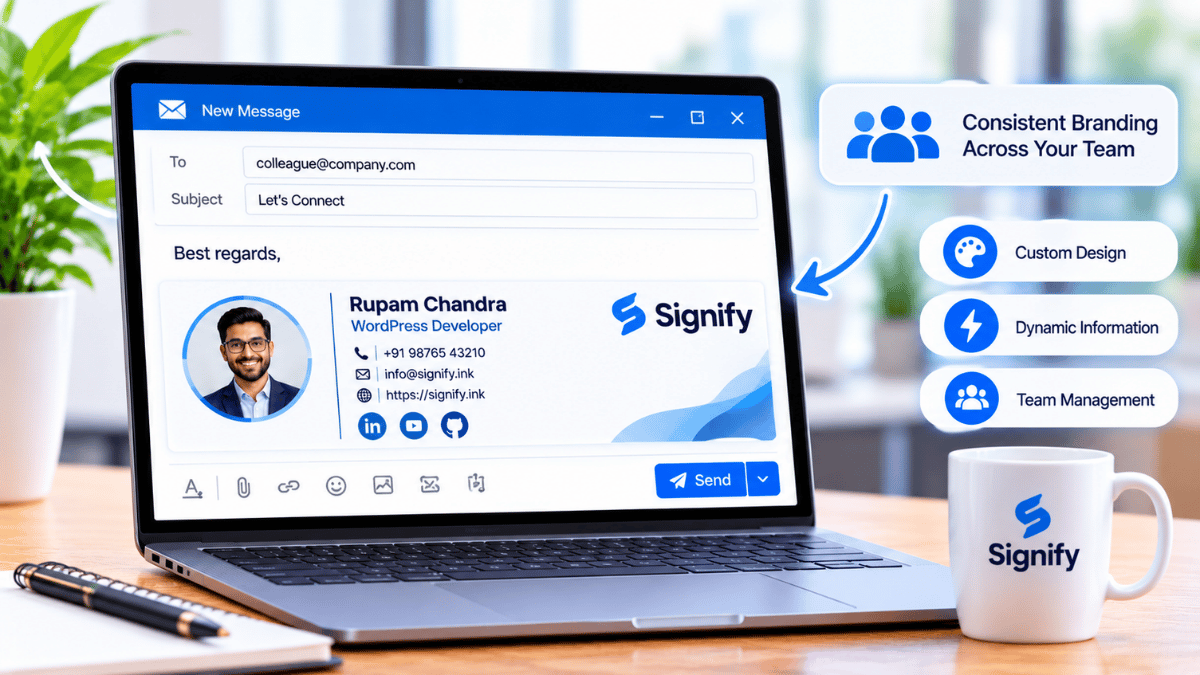
Adding a card to an email signature is passive sharing — the card appears in every outgoing message but does not require the recipient to do anything. This is good etiquette because it does not impose. The etiquette shifts if the card is being used to add value in a specific conversation rather than as a signature; in that case, the card should be shared with context, not just included.
LinkedIn and messaging
Sending a card via LinkedIn DM or messaging app is fine when there is a specific reason. Sending a card to someone you have never spoken to, in any channel, is the digital equivalent of a cold sales email. The etiquette does not change based on the channel.
Frequently asked questions
Should I ask before sharing my digital business card?
Yes, in most contexts. Asking before sharing signals respect for the recipient’s inbox and makes them more likely to save the contact. The exception is when the exchange is expected — at a conference, for example, when both parties are clearly there to network. Even then, a short “may I share my card?” is a good habit.
What should I say when I share my card?
Reference one specific thing from the conversation. “It was great chatting about [specific topic]” does more work than a generic greeting. If a mutual connection introduced you, mention that. If you promised to send something, include the promise.
How quickly should I follow up after sharing a card?
The standard window is 24–48 hours. After 72 hours, the recipient has usually moved on, and the follow-up reads as an afterthought. Same-day follow-up is best in most contexts; next-morning is acceptable. The specific timing matters less than the consistency of the habit.
Is it rude to share my card without asking?
In many contexts, yes — particularly if the recipient did not express interest in staying in touch. Unsolicited sharing is the digital equivalent of interrupting a conversation to hand someone a brochure. The exception is high-volume events where sharing is the expected format; even then, some signaling of interest from the recipient is courteous.
Should I share my digital card with everyone at a conference table?
Share with people who expressed interest. Bulk-sharing to a table is polite in form but not in effect — it treats the exchange as a broadcast rather than a conversation. If someone at the table asks, share; if they do not, do not.
How many links should my digital card have?
Three or four well-chosen links is the right number. A card with twelve links is not more impressive — it is harder to read. The recipient who wanted to reach you will find the one link they need; the recipient who was going to ignore you will ignore a longer card faster.
Is it appropriate to put my digital card in my email signature?
Yes. Adding a Signify email signature is passive sharing — the card appears in every message but does not require the recipient to do anything. This is good etiquette because it does not impose. The etiquette shifts if the card is being used to add value in a specific conversation rather than as a signature.
What should I do if someone shares their card with me?
Acknowledge it and, if appropriate, share yours in return. A short message — “thanks for the card, here is mine” — is the correct response. Save their contact information promptly; the recipient will notice if you do not.
Should I use a lead-capture form on my card?
Yes, when the context warrants it. The lead-capture form is a two-way exchange — the recipient shares their details in exchange for access to your profile. The etiquette is that the form should be offered, not required; if a recipient prefers not to fill it out, the card should still be accessible.
Does digital card etiquette differ from paper card etiquette?
The principles are the same — ask, provide context, follow up — but the volume differs. A digital card takes one second to share, which means it takes one second to spam. The etiquette is partly about resisting that ease. A paper card that is handed out without context is also discarded; a digital card that is sent without context is discarded faster.
The etiquette starts with the card
A card that is well-designed, current, and easy to save makes the etiquette easier to follow. Start there, then follow up deliberately.
Create your free digital card