Signify.ink

Bootstrapped founders face a specific networking problem that funded founders do not: every hour spent networking has to justify itself against the hours spent building the product, closing customers, and keeping the lights on. There is no growth team, no BD hire, no events budget. That constraint is not a disadvantage — it is a forcing function that rewards a systematic approach over a scattershot one. This guide lays out a four-phase networking engine built specifically for a founder who is running lean: Foundation → Engagement → Nurture → Scale. Each phase is designed to run in under an hour a week, and the whole system is grounded in a Signify digital business card that turns every introduction into a tracked, updatable contact.
The central insight is that bootstrapped founders do not lose opportunities because they lack access. They lose them because the networking they do is not cumulative. Meeting 50 people at a conference and saving 5 of their contacts is worse than meeting 10 people and saving all 10 with context attached. The point of a system is not to network more — it is to make sure that every handshake, event, and warm intro adds to a durable asset (a network) rather than evaporating the moment you walk out of the room.
The founder’s dilemma: time vs. impact
Most founders understand that networking matters. What they miss is that the type of networking matters far more than the volume. A bootstrapped founder can easily spend 15 hours a week at events, cold DMing, and joining communities — and still end up with a network that produces almost nothing. The problem is rarely effort. It is almost always structure.
There is a well-documented pattern in startup research: warm introductions convert at dramatically higher rates than cold outreach, often by an order of magnitude depending on the target. Funded founders run into this constantly when raising capital — a warm intro from a portfolio founder will land a partner meeting; a cold email will almost never. The same pattern holds for early customers, hires, and partners. Which means the highest-leverage networking activity for a bootstrapped founder is not adding more people to your network. It is converting the people you already know into effective connectors.
That reframe is the foundation of the four-phase system that follows. The goal is not a bigger network. The goal is a network that compounds — where every introduction you make today makes future introductions easier. A bootstrapped founder with 200 well-nurtured contacts will outperform a founder with 5,000 passive LinkedIn connections, every time.
The 1-hour-per-week figure is not a target to hit on day one. It is what the system costs once it is running: a weekly review of new contacts, one or two warm-intro requests, and a short burst of follow-up. That is not a networking strategy — it is a networking habit. It is also the only version of networking that a bootstrapped founder can sustain for 18 months while still shipping product.
Phase 1: Build a strong foundation
The most common founder mistake is starting with activity instead of definition. Before you attend a single event or send a single message, you need a clear answer to three questions: why you are networking, who you are trying to reach, and how you will be presented when you do reach them. Skipping this step is what produces the “I met 50 people at a conference and got nothing” outcome.
Define your why
“To grow my network” is not a goal. “To meet three investors in Q3 for a seed raise,” “to find my first ten beta customers in vertical X,” or “to hire a senior engineer with infrastructure experience” — those are goals. The distinction matters because each one implies a different channel, a different message, and a different definition of success. A founder with a clear goal can ignore 90% of networking opportunities and still win. A founder without one chases everything and finishes nothing.
Identify ideal connections
Write down the profile of the person you are trying to meet. Industry, role, company stage, geography, and — critically — where they spend time online and in person. This is the input to every subsequent phase. A founder looking for seed investors needs to be in different rooms (and Slack groups) than a founder looking for their first B2B customer. Conflating the two produces noise.
Optimize your digital presence
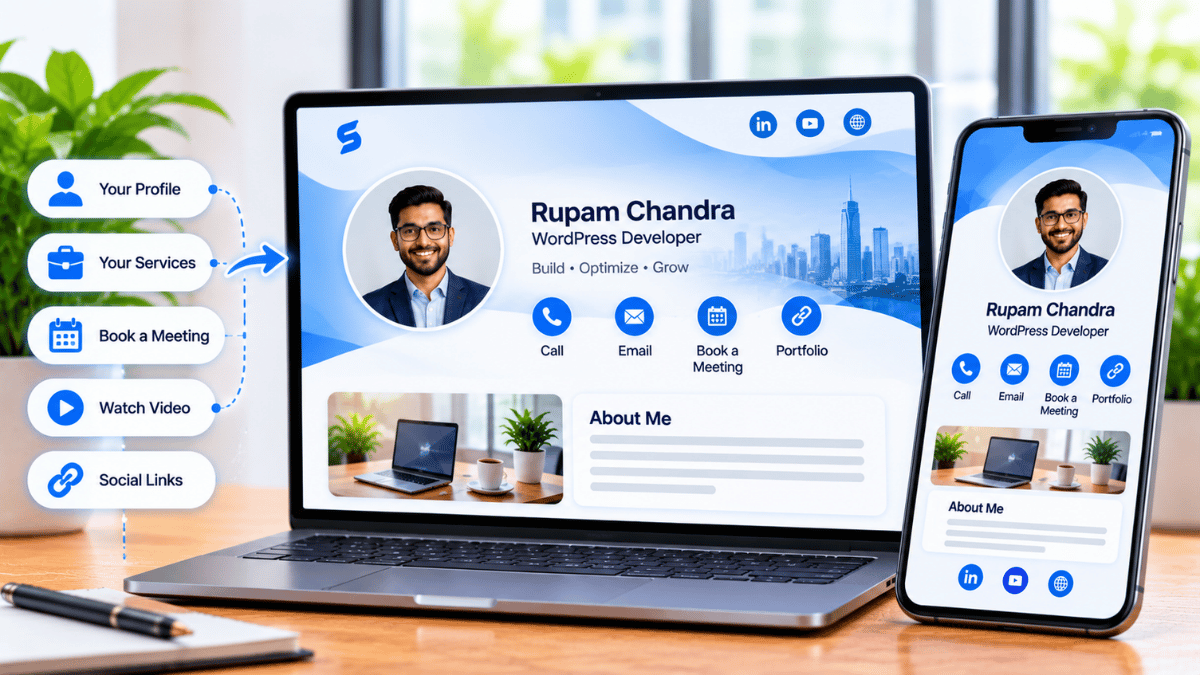
Before you can ask anyone for an introduction, they need to be able to check you out. A polished Signify digital business card is the fastest way to give a new contact a clear, professional picture of who you are and what you’re building. Your card should include:
- A clear, professional profile photo
- A one-line bio that says exactly what you do (not “Founder at [Company]” — that is a title, not a pitch)
- A link to your LinkedIn, your company site, or both
- A booking link so an interested contact can schedule a call without an email exchange
- One or two proof points — a case study, a portfolio link, a press mention
Once your card is built, the same profile doubles as your email signature. That means every follow-up email carries your contact profile, so the recipient never has to search for your details or dig through their inbox to find your link.
Phase 2: Engage authentically
With the foundation in place, the goal is to connect with the right people without burning time on the wrong channels. A bootstrapped founder should pick two channels and do them well, rather than spreading thin across six. The three that tend to work best for early-stage founders are content creation, community participation, and warm-intro-driven outreach — in that order of leverage.
Content creation
Sharing what you’re learning — in LinkedIn posts, on a personal blog, or in a small newsletter — is the highest-leverage inbound networking channel a founder has. It is slow, but it scales. A single post that resonates with your target audience can produce more qualified inbound connections than a month of cold outreach. The right metric here is not impressions; it is the number of people who reach out to you because of something you wrote.
Community participation
Niche Slack groups, Discord servers, subreddits, and Slack communities of practice are where the founders you want to meet actually hang out. The goal is not to promote — it is to be genuinely useful. Answer questions, share resources, and offer to help without expectation. Over time, this produces a reputation, and reputation is what converts community members into warm introductions.
Targeted outreach
Once you have a reputation and a clear profile, direct outreach becomes viable. The key is personalization: reference something specific the person wrote, said, or did, and make a concrete, small ask. A generic “would love to connect” message is worse than no message at all — it damages your reputation as effectively as it saves time. Warm intros from a mutual contact are dramatically more effective than cold outreach, which is why phase 3 (nurturing existing contacts) matters so much.
Phase 3: Nurture relationships
The single biggest drop-off point in founder networking is the gap between “met at a conference” and “has a relationship.” Most founders stop at the exchange. The ones who build durable networks push through a short, repeatable nurture sequence that turns an introduction into a relationship. It has four steps, and it runs on a schedule — not on impulse.
Step 1: Initial follow-up (within 24 hours)
Within a day of meeting someone, send a short, specific message that references the conversation. This is not a template — it is a genuine acknowledgement that you were paying attention. A typical opener: “Great chatting about [specific topic] yesterday. The [specific resource they mentioned] you recommended is on my list. Would love to stay in touch.” If you use a Signify card, your contact details are already in their phone from the tap or scan, so the message is unencumbered by logistics.
Step 2: Provide value (within 1–2 weeks)
Find a way to be useful without being asked. Send a relevant article, make an introduction to someone in your network, or share a piece of feedback on something they mentioned. This step is what separates a founder who “adds people” from one who “builds a network.” It should be no-strings-attached — if there is an obvious ask attached, the gesture reads as transactional and the value evaporates.
Step 3: Periodic check-in (every 1–3 months)
Consistency matters more than content. A short message every few months — a “how have things been?” or a genuine congratulation on something they shipped — keeps you in the top of their mind without requiring a real-time relationship. This is where a lightweight CRM or even a spreadsheet becomes essential: without a system to remind you, “periodic” becomes “never.”
Step 4: Make an “ask”
Only after you have established a relationship and provided value should you ask for something. When you do, be specific and small: “I’m looking for an intro to [specific type of person] — do any names come to mind?” is a completely reasonable ask from someone you have genuinely helped. A vague “let me know if you know any investors” is not.
Phase 4: Scale with systems
At around 50 contacts, a founder can keep their network in their head. At around 150, they cannot. The transition from “I know people” to “I have a network” requires a system — not because the founder is forgetful, but because relationships decay without maintenance and the human brain is not built to track 150 follow-up schedules in parallel.
A simple CRM is enough
The system does not need to be expensive. A spreadsheet with name, context, last-touch date, and next-touch date is sufficient for most early-stage founders. The point is not to track every interaction — it is to make sure that nobody who should hear from you falls off the radar. Advanced founders use a lightweight tool (Notion, Airtable, or a CRM like Pipedrive’s starter tier), but the format is not what matters. The habit is.
Where Signify fits the system
A Signify card is not a CRM replacement. It is the input layer of the system. Every time someone scans your card, taps your NFC card, or views your profile, that interaction is captured — views, saves, and link clicks included. For founders who use Signify’s Zoho CRM integration, those contacts sync automatically into the CRM, which removes the manual data entry step that is the most common failure point in a founder’s networking system.
For founders running a small team (or planning to), Signify Teams extends this to the whole company — so that when a co-founder or early hire meets someone at an event, the contact lands in a shared directory rather than in an individual’s inbox. That is the difference between a founder’s network and a company’s network.
The scaling ceiling
A bootstrapped founder can realistically maintain 150–250 well-nurtured relationships. Beyond that, the maintenance cost exceeds the value. The goal of the system is not to have the largest network — it is to have the most effective one at the size you can actually maintain. A founder who knows 200 people well will consistently outperform a founder who has 2,000 loose connections, because the depth is what produces warm intros.
Why Signify fits the bootstrapped model
Most networking tools are built for enterprise teams with budget to spare. Signify is built for the opposite profile: an individual professional who needs the tooling to be cheap, fast to set up, and useful from day one. Three things make it a natural fit for a bootstrapped founder.
Free tier that is actually usable
Core card creation, sharing, and analytics are free. Paid plans are only worth it once you have specific needs (custom branding, more cards, team features). See the pricing page.
Set up in minutes, not weeks
No design work, no IT integration, no vendor onboarding. Create a card at signify.ink/card/newcard and you’re live.
Fits into whatever you already use
QR code, NFC tap, direct link, or email signature — the card works with the tools and channels you already use, without adding new ones.
Analytics that matter for a founder
See who viewed your card, what they clicked, and which events produced engagement. That is the input to phase 4 of the system.
For founders who eventually spin up a team, Signify Teams provides branded templates, shared contacts, and team analytics — so that the founder’s networking system scales into a company networking system without a rebuild. And for founders who want a public-facing company page, Business Brief gives the company a single branded destination with contact options and links to every team member’s card.
The tooling is not the strategy — but it removes the friction that usually kills the strategy. A founder who has to manually enter every contact into a spreadsheet will stop doing it within a month. A founder whose contacts sync automatically into a card-based system will keep doing it for years.
The three metrics that matter
A founder’s networking system should be measured, or it becomes a hobby. Three metrics are sufficient for an early-stage founder — more than that produces noise.
The first metric is the output: is your network producing introductions that matter? The second metric is the process: are you actually following up on the people you meet? The third metric is the maintenance signal: is your network staying warm, or slowly going cold?
If a founder can move the middle metric — follow-up rate — from 20% to 70%, everything else compounds. That is the single most leveraged improvement in the system, and it is almost entirely a tooling problem. A Signify card makes follow-up one tap away; a paper card makes it a monthly chore.
Common founder networking mistakes
These are the mistakes that consistently show up in founder networking, and the corrections that usually fix them.
Chasing volume over depth
The instinct to “meet everyone” is understandable but wrong at the early stage. A founder with 200 well-maintained relationships gets more inbound intros than a founder with 5,000 cold LinkedIn connections. The correction is to set a target of 3–5 new high-quality contacts per week and to actually nurture each one, instead of saving 30 cards into a spreadsheet that never gets opened.
Treating networking as a separate activity
Founders who “block time for networking” usually fail, because networking is not a separate activity — it is the natural byproduct of building the company in public. Sharing what you are learning, answering questions in communities, and following up with people you meet is not time away from the product. It is how the product gets discovered.
Skipping the ask
Founders often build relationships and then fail to ask for anything, out of a fear of seeming transactional. The result is a warm network that produces no warm intros. The correction is to make small, specific, respectful asks after you have provided value — and to make them regularly. Nobody minds being asked for something small. They mind being asked for something vague and demanding.
Relying on memory instead of system
The founders who build durable networks are almost always the ones who wrote things down. A lightweight CRM, a spreadsheet, or a card-based system — the format matters less than the habit. The habit is what turns “we met once at an event” into “we are still in touch two years later.”
Not making yourself easy to follow up with
A founder who hands out a paper card is asking the other person to do all the work: enter the contact, look up the LinkedIn, remember the context. A founder with a Signify digital card is doing that work for them, which is why the follow-up rate is dramatically higher. The correction is not effortful — it is a one-time setup that changes every subsequent interaction.
Frequently asked questions
How much time should a bootstrapped founder spend on networking?
The system in this guide runs on roughly 1 hour per week once it is set up: a weekly review of new contacts, one or two warm-intro requests, and a short burst of follow-up. The first few weeks take longer because you are building the foundation. The ongoing cost is small — the point is consistency, not volume.
What is the difference between a founder’s network and a company’s network?
A founder’s network is the relationships the founder personally maintains. A company’s network is the sum of relationships across every employee, plus a shared record of those contacts. Signify Teams supports the transition from founder-led networking to company-wide networking with shared contacts and team analytics.
Do warm intros really convert better than cold outreach?
Yes, dramatically so. In both fundraising and B2B sales, warm introductions from a mutual contact convert at roughly 10× the rate of cold outreach. That is why the highest-leverage founder networking activity is not meeting more people — it is nurturing the people you already know into effective connectors.
Why use a digital business card instead of a paper one?
Because the follow-up rate is what determines whether networking produces results, and paper cards fail at follow-up. An estimated 88% of paper cards are discarded within a week, and most of the surviving few never get entered into a system. A Signify digital card closes that gap by making the contact saveable in one tap, updatable automatically, and traceable in analytics.
What should a founder’s digital card actually include?
A clear profile photo, a one-line bio that says what you do (not just your title), a LinkedIn or company link, a booking link, and one or two proof points. The card should be specific enough that someone who just met you can understand what you do and why it matters within 10 seconds of opening it.
Do I need a CRM as a solo founder?
Not in the enterprise sense. A spreadsheet with name, context, last-touch date, and next-touch date is enough up to around 150–200 contacts. What matters is the habit of updating it. Signify’s Zoho CRM integration supports founders who want automation without building a custom stack.
Is Signify free for a bootstrapped founder?
Yes. The free tier covers core card creation, sharing, and analytics — enough for most early-stage founders. Paid plans add more cards, custom branding, and team features. See the pricing page for details.
How do I track whether my networking is working?
Three metrics: the number of high-quality warm intros received this month, the percentage of new contacts you actually followed up with, and the percentage of your top 50 contacts you have touched in the last 90 days. Move the follow-up metric first — it is the most leveraged.
Can Signify help with fundraising specifically?
Signify is not a fundraising tool, but it is a networking tool that fundraisers rely on. A digital business card makes it easy for a VC you met at a demo day to save your contact, find your LinkedIn, and book a follow-up call — which is exactly what you want after an initial intro.
What is the first step to build this system?
Create a free Signify card with a clear one-line bio and a booking link. That single step gets you to phase 1 of the framework in about 5 minutes. The other three phases build on top of it.
Build a network that compounds
Replace the paper card with a Signify digital profile that shares in seconds, stays current forever, and gives every introduction a reason to follow up.
Create your free digital card